




1 Introduction – What does AI mean in the supply chain?
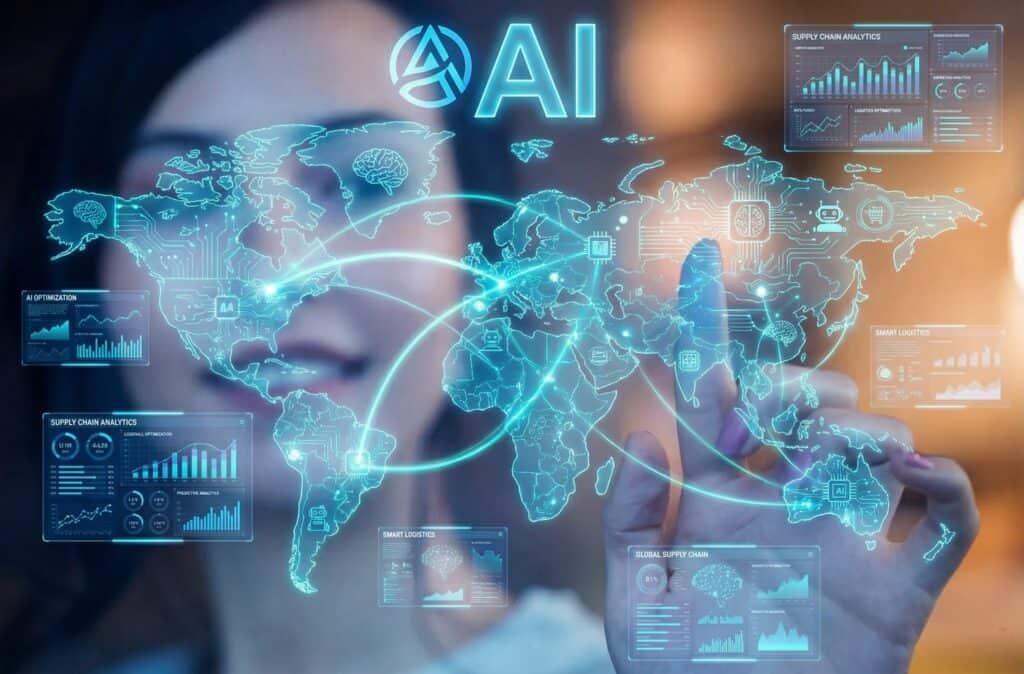
Artificial intelligence (AI) has evolved from a futuristic concept to a driving force in the modern economy and is revolutionizing industries around the world. In the field of supply chain management in particular, AI is unleashing its full potential by transforming traditional, often rigid processes into dynamic, intelligent and autonomous systems.
The use of AI in the supply chain is about much more than just automating routine tasks; it is about analyzing vast amounts of data in real time, making accurate predictions and enabling informed decisions that increase the efficiency, resilience and sustainability of the entire value chain. AI uses data from all stages of the supply chain – from procurement, production and warehousing to delivery to the end customer – to continuously improve processes and create a decisive competitive advantage. This introduction lays the foundation for a deeper understanding of the specific applications and transformative potential of AI in logistics and procurement.
1.1. What is AI in supply chain management?
At the core of supply chain management (SCM), the use of artificial intelligence aims to maximize the efficiency and effectiveness of the entire supply chain through data-driven intelligence. AI systems analyze huge and complex data streams in real time that originate from various stages of the supply chain – be it sensor data from production, inventory information, traffic data for logistics or market data for demand forecasting. Sophisticated machine learning algorithms recognize patterns, correlations and anomalies in these data volumes that would remain invisible to humans. On this basis, they make precise predictions about future events, such as fluctuations in demand or potential supply bottlenecks, and support decision-makers with specific recommendations for action. The overarching goal is the gradual automation of the supply chain, in which intelligent systems not only take on operational tasks but also make tactical and strategic decisions autonomously in order to make the supply chain more resilient, agile and cost-efficient.
1.2. AI in logistics & procurement – definition & differentiation
While AI in supply chain management encompasses the entire value chain, its use in the specific areas of logistics and procurement can be clearly delineated. In logistics, AI focuses on optimizing the physical flow of goods.
Specific applications can be found here in dynamic route planning, where AI algorithms analyze traffic data, weather conditions and delivery time windows in real time to determine the most efficient transport routes. In warehousing, AI controls autonomous vehicles and robots, optimizes warehousing through intelligent storage and retrieval strategies and ensures precise inventory management to minimize storage costs and avoid shortages.
In procurement, on the other hand, AI primarily supports strategic and operational purchasing processes. This includes automated supplier selection and evaluation, in which AI analyzes the performance, reliability and sustainability of suppliers based on historical data and real-time information. It also enables proactive risk analysis by identifying potential supplier failure risks at an early stage and suggesting alternative procurement sources. By automating negotiations and analyzing contracts, AI helps to significantly reduce transportation and procurement costs and strengthen the resilience of procurement.
| Criterion | Traditional method | AI-supported method |
| Data analysis | Manual, based on historical data, reactive | Automated, in real time, predictive |
| Process control | Rigid, rule-based, low flexibility | Dynamic, self-optimizing, high agility |
| Decision making | Experience-based, often delayed, subjective | Data-driven, immediate, objective |
| Use of resources | Often inefficient, high buffer stocks | Optimized, needs-based, minimal waste |
| Risk management | Reactive, limited to known risks | Proactive, recognizes unknown patterns, resilient |
1.3. What is generative AI and how is it used in supply chains?
Generative AI is a branch of artificial intelligence that is able to create new and original content instead of just analyzing or acting on existing data. These models, such as large language models (LLMs), can generate texts, images, code, plans or complex simulations.
In the context of the supply chain, generative AI opens up completely new possibilities that go beyond traditional predictive analytics. Instead of just predicting what might happen, generative AI can actively design solutions and scenarios. One prominent field of application is scenario analysis and planning. For example, generative AI can simulate alternative supply chain models for crises such as natural disasters or geopolitical conflicts and create optimized response plans. It can also be used to dynamically plan complex logistics networks by independently designing optimized supply chain configurations, taking into account countless variables and constraints. By uniquely combining machine learning with creative process logic, generative AI can develop innovative solutions to challenges that previously required human creativity and tedious manual planning, significantly increasing the strategic agility of organizations.
2. important areas of application for AI in supply chains
The transformative power of artificial intelligence manifests itself in the supply chain through a multitude of concrete use cases that go far beyond theoretical concepts and are already revolutionizing operational processes today. From warehouse optimization and the automation of routine tasks to proactive risk management – AI technologies are becoming a decisive factor for the future viability of companies. They make it possible to seamlessly link technological innovations with the practical, everyday processes of the supply chain and thus achieve a new level of efficiency, transparency and resilience. The following examples illustrate how AI is permanently changing the supply chain and helping companies to meet the increasing demands of a globalized and volatile market.
2.1. Demand forecasting and warehouse optimization
One of the most effective applications of AI in the supply chain lies in precise demand forecasting and the associated inventory optimization. Traditional forecasting methods, which are often based on historical sales figures, quickly reach their limits in dynamic markets. AI systems, on the other hand, are able to analyze a much larger and more diverse database. They not only take into account internal sales data, but also a variety of external factors such as weather forecasts, socio-economic trends, public holidays, marketing campaigns and even unforeseen events such as pandemics or political unrest. By analyzing these complex interrelationships, AI algorithms create significantly more accurate and reliable demand forecasts. This precision enables companies to optimize their inventory levels, significantly reducing storage costs and minimizing costly stock-outs. Better coordination of production and inventory planning not only ensures greater efficiency, but also improved customer satisfaction through consistently high availability of goods.
2.2. Supply chain automation and process optimization
The automation of processes is another key area in which AI plays to its strengths and significantly increases the efficiency of the supply chain. AI-controlled systems are increasingly taking over manual and repetitive tasks that were previously error-prone and time-consuming. In incoming and outgoing goods, for example, intelligent camera systems and robots can carry out the recording, checking and sorting of goods fully automatically. Adaptive algorithms continuously optimize processes in the warehouse and in production by dynamically adapting to changing conditions. For example, if the system detects an impending bottleneck in a production line, it can automatically divert material from another area or suggest an alternative production route. This ability to self-optimize not only drastically reduces manual errors, but also significantly increases the overall efficiency and flexibility of the supply chain. Employees are relieved of routine tasks and can concentrate on more complex, value-adding tasks.
2.3. Supplier management with AI
A robust and resilient supplier network is the backbone of any successful supply chain. A comprehensive supplier management solution can provide the foundation for successful AI integration. AI offers powerful tools to take supplier management to the next level.
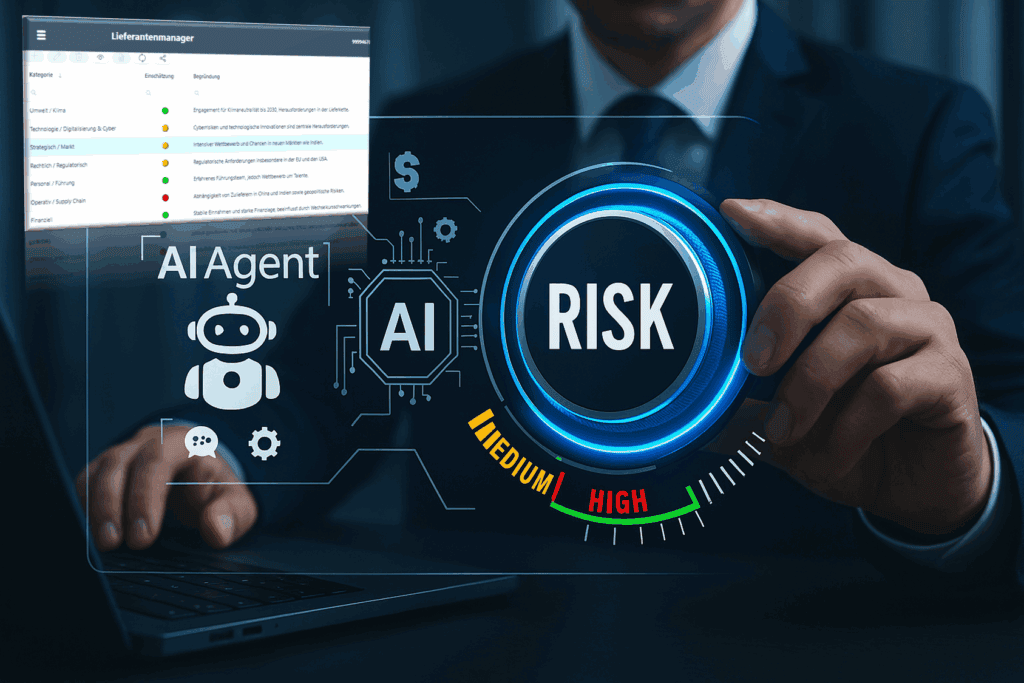
AI systems continuously analyze a wide range of data to assess the performance and reliability of suppliers. This includes not only hard facts such as delivery reliability and price trends, but also soft factors such as the supplier’s financial stability, sustainability efforts or geopolitical risks in the region of origin. Based on this comprehensive performance analysis, the AI can identify potential risks with individual suppliers at an early stage and proactively make recommendations for action.
For example, if the system sounds the alarm because a key supplier is showing signs of financial instability, it can simultaneously suggest alternative suppliers that have already been checked. This proactive risk management strengthens the resilience of the entire supply chain and enables companies to respond quickly and effectively to disruptions instead of only reacting when it is already too late.

2.4. Generative AI in the supply chain – new approaches
Recent advances in the field of generative AI are opening up completely new and innovative approaches to supply chain management. While traditional AI is primarily focused on analysis and prediction, generative AI can actively create new solutions and complex models. One particularly promising area of application is the dynamic planning and design of complex supply chain networks. Instead of simply optimizing existing networks, generative AI can design completely new, optimized supply chain models at the push of a button, which are geared towards specific goals such as cost minimization, maximum resilience or the lowest possible CO2 emissions.
Another revolutionary approach is the simulation of alternative scenarios to minimize risk. Generative AI can run through thousands of possible future scenarios in a matter of seconds – from supplier failures to natural disasters to sudden spikes in demand – and develop the optimal response strategies for each scenario. This ability to proactively plan for the future and prepare for a wide range of eventualities gives companies unprecedented strategic agility and resilience.
| Area of application | Main benefit | Implementation effort | Time horizon |
| Demand forecast & warehouse optimization | Reduction of storage costs and shortages | Medium | Short to medium term |
| Automation & process optimization | Increased efficiency, reduction of manual errors | High | Medium to long term |
| Supplier management | Increasing resilience, proactive risk management | Medium | Medium-term |
| Generative AI | Simulation of scenarios, innovative solutions | Very high | Long-term |
3. the advantages of AI in the supply chain
The implementation of artificial intelligence in the supply chain is not just a technological modernization, but a strategic step that brings far-reaching and measurable benefits. Companies that make targeted use of AI solutions benefit from a significant increase in efficiency, a noticeable reduction in costs and an improved sustainability balance. However, the long-term benefits of intelligent systems go far beyond mere operational improvements. It manifests itself in increased agility, stronger competitiveness and the ability to make data-driven decisions that future-proof the company. The following sections highlight the key benefits that AI brings to the operational management of the supply chain.
3.1. Increasing efficiency through AI technologies
One of the most immediate and tangible benefits of using AI is the massive increase in efficiency along the entire supply chain. AI technologies are able to identify bottlenecks and inefficiencies in complex processes in real time, which often remain hidden to human analysts. By continuously analysing production, logistics and inventory data, AI systems uncover potential for improvement and suggest specific optimization measures. The automation of routine processes, from order processing to invoice verification, not only saves valuable time and reduces personnel costs, but also minimizes the error rate. Another decisive factor is the ability to react more quickly to unforeseen changes in the market. For example, if demand for a product suddenly changes, AI-driven systems can adjust production and delivery schedules in minutes to avoid bottlenecks or overstocking. This increased speed of response and agility leads to a leaner, more cost-effective and ultimately more competitive supply chain.
3.2. Promoting sustainability with AI
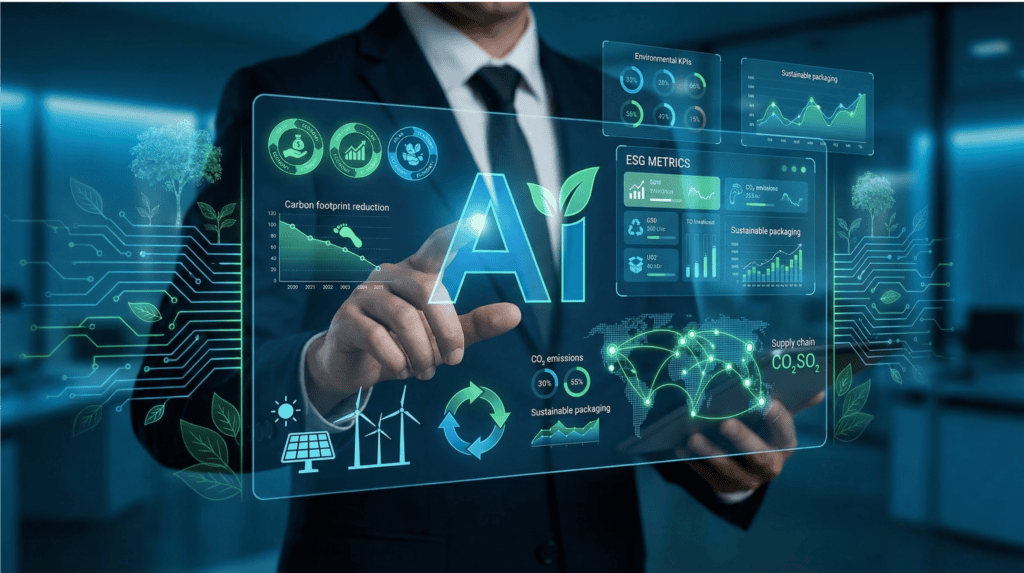
In addition to the economic benefits, artificial intelligence is making an increasingly important contribution to the environmental sustainability of supply chains. A key lever here is the optimization of transport routes. AI algorithms calculate not only the fastest but also the most fuel-efficient routes by taking traffic volume, vehicle utilization and topography into account.
This leads to a direct reduction in CO2 emissions. Warehouse optimization also contributes to sustainability: More accurate demand forecasting avoids overproduction and unnecessary warehousing, which reduces energy consumption in warehouses and minimizes the waste of resources. In addition, AI can help companies make more sustainable decisions when selecting suppliers. AI systems can analyze and evaluate the sustainability certificates, energy consumption and social standards of thousands of potential suppliers. Through detailed consumption analyses along the entire value chain, AI helps to identify resource-intensive processes and replace them with more sustainable methods, thus actively supporting companies on their way to greener logistics.
3.3. Competitive advantages through data-supported decisions
In today’s data-driven world, the ability to make quick and informed decisions is a key competitive advantage. AI systems transform the vast amounts of data generated in a supply chain into valuable, actionable knowledge. Predictive analytics and precise forecasting enable management to not only react to current events, but to proactively shape the future.
Companies can identify market trends and shifts in demand at an early stage and adapt their strategy accordingly before the competition does. This data-supported foresight leads to greater agility and resilience throughout the organization. Instead of having to improvise in the event of a crisis, companies can fall back on scenarios and recommendations for action prepared by AI. The ability to minimize risks, seize opportunities faster and continuously optimize their own supply chain based on data secures long-term competitive advantages and positions the company as a leader in its industry.
| Advantage category | Concrete effects | Measurable KPIs | Time horizon for realization |
| Increased efficiency | Automation, bottleneck detection, faster response | Cost reduction per unit, reduction in throughput time, OEE increase | Short to medium term |
| Sustainability | CO2 reduction, resource conservation, supplier selection | CO2 footprint per unit, waste quota, proportion of sustainable suppliers | Medium-term |
| Competitive advantages | Greater agility and resilience, better decisions | Time-to-market, forecast accuracy, market share | Medium to long term |
4. challenges in the implementation of AI
Despite the enormous potential, the introduction of artificial intelligence in the supply chain is not a sure-fire success. The implementation of AI systems presents companies with a number of challenges, ranging from technical hurdles to organizational changes and legal frameworks. A successful AI transformation requires realistic expectations, careful planning and a deep awareness of the necessary requirements. Companies need to address the issues of data quality, system integration and change management as well as data protection and ethical responsibility. The following sections highlight the biggest challenges and provide important tips for successful implementation.
4.1. Data quality & system complexity of AI in the supply chain
The performance of any AI application stands and falls with the quality of the data with which it is trained and operated. One of the biggest hurdles when implementing AI in the supply chain is therefore the often inadequate data quality. Inconsistent, incomplete or incorrect data from different sources can distort the analysis results and, in the worst case, lead to costly wrong decisions.
The standardization of different data formats that originate from a variety of systems such as ERP (Enterprise Resource Planning) or SCM (Supply Chain Management) is often a complex and resource-intensive undertaking. The integration of AI solutions into these existing IT landscapes, which have often grown over the years and are highly individualized, poses a further significant technical challenge. Without a solid, clean and well-structured data basis and seamless system integration, the benefits of AI solutions can be significantly reduced or even fail to materialize altogether.
4.2. Data protection and legal framework
The use of AI in the supply chain inevitably involves the processing of large amounts of data, often including sensitive information such as customer data, pricing strategies or confidential contract details. This brings the issues of data protection and legal compliance into focus. Solid risk and compliance management is therefore essential.
Companies must ensure that their AI applications comply with the strict requirements of the General Data Protection Regulation (GDPR) and other national and international data protection laws. This requires not only technical measures for data security, but also a clear governance structure for handling data. The question of responsibility for AI-supported decisions poses a particular challenge. If an autonomous system makes a decision that leads to financial damage or a breach of the law, clarifying the question of liability is often complex. Companies must therefore create a clear legal and ethical framework for the use of AI in order to minimize legal risks and maintain the trust of customers and partners.
4.3. Employee training and change management
The technological implementation of AI is only one side of the coin. The organizational and cultural anchoring in the company is at least as important. A common obstacle is the lack of AI know-how among employees, which slows down the introduction and use of new systems. Fear of losing their jobs or skepticism towards new, complex technologies can lead to resistance within the team.
Comprehensive change management is therefore essential. Employees must be given targeted and extensive training to enable them not only to use the new tools, but also to understand, interpret and scrutinize their results. The aim is to create acceptance for the new technologies and prepare employees for the changed roles and task profiles. Ultimately, a change in corporate culture is necessary – towards a culture that takes data-driven work, continuous learning and collaboration between man and machine for granted.
| The challenge | Description | Recommended solution approach | Responsible area |
| Data quality & integration | Inconsistent, incomplete data; complex system landscape | Development of a central data platform, implementation of data governance | IT, data management |
| Data protection & law | Compliance with the GDPR, unclear liability for AI decisions | Carrying out data protection impact assessments, drawing up ethical guidelines | Legal department, Compliance |
| Employee training & change management | Lack of know-how, acceptance problems, fear of change | Development of a training program, open communication, involvement of employees | Personnel department, management |
| Costs & ROI | High initial investment, uncertain return on investment | Start with small pilot projects, clear KPI definition, agile approach | Management, Controlling |
5 The future of AI in supply chain management
The development of artificial intelligence in supply chain management is only just beginning, but the future promises an even more profound transformation. Upcoming developments such as fully autonomous supply chains and the increasingly creative use of generative AI will fundamentally change the way we produce, store and transport goods in the coming years. The vision is a supply chain that is not just reactive and predictive, but proactive, self-learning and self-optimizing. The following sections provide an outlook on the motivating, future-oriented, sustainable and innovation-driven future of AI in the supply chain.
5.1. Autonomous supply chains and predictive analytics
The vision of the future is the autonomous supply chain – a fully automated, self-controlling system that operates with minimal human intervention from procurement to delivery. In this scenario, predictive analytics will play an even more central role. AI systems will not only forecast demand, potential bottlenecks or market behavior with even greater precision, but will also autonomously make the necessary adjustments throughout the chain. For example, if the AI detects that a storm will block an important shipping route, it not only automatically reroutes the affected deliveries, but also adjusts the production plans in the affected plants and proactively informs end customers about possible delays. This level of foresight and autonomy enables far better crisis management and makes the supply chain extremely resilient to unforeseen disruptions.
5.2. Generative AI-supported innovations
Generative AI is becoming a driver of innovation in supply chain management. Its ability to create completely new solutions will revolutionize strategic planning. Companies will be able to design new, highly efficient and sustainable supply models that are perfectly tailored to new products or markets at the touch of a button. Another ground-breaking aspect is the ability to simulate the impact of strategic decisions in real time. Managers can virtually run through different scenarios – such as building a new factory, entering a new market or switching to a sustainable energy source – and immediately see their complex impact on costs, delivery times and carbon footprint. In the event of a crisis or sudden growth opportunities, generative AI can develop innovative and unconventional solutions that human planners might never have thought of, exponentially increasing the company’s adaptability and innovative strength.
5.3. Integration of AI in ERP and SAP systems
The future of AI in the supply chain does not lie in isolated stand-alone solutions, but in the deep and seamless integration into the central nervous systems of companies: the ERP (Enterprise Resource Planning) and SAP systems. By enriching these established platforms with AI functions, the systems themselves will become more intelligent and autonomous.
In future, an SAP-supported system will not only post transactions, but also proactively identify optimization potential in purchasing, automatically adjust stock levels and communicate independently with suppliers. This seamless integration into existing company software is crucial for the scalability and success of AI initiatives. It not only improves the database, as all relevant information flows together in one place, but also enables the end-to-end automation of workflows across departmental boundaries. Merging AI with companies’ core systems will take efficiency to a new level and gradually turn the vision of the autonomous supply chain into reality.
6 AI in the supply chain: risks
In addition to the numerous benefits and implementation challenges, the use of artificial intelligence in the supply chain also entails specific risks that require careful management.
One of the biggest risks lies in the strong dependence on data quality and availability. You can find out more about AI-specific risks in our dedicated article. If the underlying data is incorrect, outdated or incomplete, this can lead to incorrect conclusions and costly wrong decisions by the AI system.
Another significant risk is the lack of transparency and traceability in so-called black box AI models. Complex neural networks often make decisions in a way that is difficult to understand, even for experts. This not only makes it difficult to analyze errors, but also raises questions of accountability and control. Companies must ensure that they retain control over their processes and do not blindly trust the decisions of an incomprehensible logic. Finally, there are also technological and organizational challenges, such as the risk of cyberattacks on AI systems or the difficulty of finding and retaining the right talent to develop and maintain the complex algorithms.
7. challenges in the implementation of AI
The successful implementation of AI in the supply chain is a complex undertaking that goes beyond the purely technical level. The key challenges can be divided into four areas.
Firstly, data quality and data integration: As already mentioned, the creation of a solid, consistent and integrated database is the basic prerequisite for any successful AI initiative.
Secondly, employee training and change management: the introduction of AI changes work processes and roles. Employees must be prepared for this change through targeted training and an open communication culture in order to reduce fears and promote acceptance.
Thirdly, data protection and ethical aspects: The handling of sensitive company and customer data requires strict data protection measures and the development of ethical guidelines to ensure the responsible use of technology.
Fourthly, the high initial investment costs and the difficulty of accurately predicting the return on investment (ROI) represent a significant hurdle for many companies, especially small and medium-sized enterprises.
8. future trends: AI in supply chain management
The future of AI in supply chain management will be shaped by three key trends that will continue to drive efficiency, transparency and sustainability. The first trend is the increased use of generative AI for process optimization. Beyond pure analysis, generative AI will proactively create new, optimized processes, supply chain designs and contingency plans. The second key trend is the ongoing integration of IoT (Internet of Things) and AI for real-time data. More and more sensors in vehicles, warehouses and on products themselves will provide a continuous stream of real-time data that AI systems will use to provide unprecedented visibility and responsiveness. The third and perhaps most important trend is the focus on sustainability and resilience through AI solutions. AI will play a key role in reducing CO2 emissions, minimizing resource consumption and making supply chains more resilient to global crises by proactively identifying risks and developing adaptive strategies.
9 What is AI in logistics?
Artificial intelligence in logistics refers to the use of intelligent, computer-aided systems to optimize, automate and control physical and information flows along the supply chain. At its core, the aim is to make logistics processes more efficient, faster and more cost-effective through data-supported decisions. AI systems analyze huge amounts of data from various sources such as transport management systems, warehouse management software and real-time tracking data in order to identify patterns, make predictions and control processes autonomously.
Challenges in implementing AI in logistics are similar to those in the supply chain as a whole, but are often more specific to the physical processes. These include the integration of data from a variety of hardware systems (e.g. sensors, vehicles), the high requirements for real-time processing of data and ensuring safety in autonomous systems such as driverless transport vehicles.
Why AI is important for modern supply chains: In a globalized world with increasing customer expectations for fast and reliable deliveries, AI is no longer a luxury but a necessity. It enables companies to master the complexity of modern logistics networks, react flexibly to disruptions and increase efficiency so that they remain competitive.
9.1. AI in logistics: examples
A striking practical example is the fictitious “KI Logistik GmbH”, which optimizes its warehouse processes through a combination of intelligent robotics and AI-based inventory forecasts. Autonomous robots store goods based on AI forecasts so that frequently required items are available more quickly. The system predicts demand for the next week and automatically adjusts warehouse layout and picking strategies, resulting in a 30% reduction in lead times and a 95% reduction in error rates.
9.2. What advantages does AI offer in logistics?
The benefits of AI in logistics are manifold and directly measurable. The central question “How can AI improve efficiency in the supply chain?” can be answered with three core benefits:
1 Increased efficiency through automated processes: AI automates time-consuming manual tasks such as route planning, freight invoicing or picking in the warehouse. This leads to considerable time and cost savings.
2. faster, data-based decisions in real time: AI systems can react immediately to unforeseen events such as a traffic jam or a machine breakdown and create alternative plans, which speeds up decision-making and minimizes the impact of disruptions.
3. greater transparency and resilience in the supply chain: AI creates complete transparency by continuously monitoring all logistics processes. Companies know where their goods are at all times and what condition they are in. This increases planning capability and resilience to external shocks.
10 Successful AI in the supply chain: guidelines
The successful introduction of artificial intelligence in the supply chain requires a strategic and step-by-step approach. You can find a more in-depth insight into the application of AI in procurement in our blog article. A structured guide will help you to master the complexity and get the maximum benefit from the technology.
-Step-by-step implementation: Start with a clearly defined pilot project in an area where quick wins are likely, e.g. demand forecasting for a specific product segment. Define clear goals, put together an interdisciplinary team and evaluate the results carefully before rolling out the solution to other areas.
-Important KPIs for measuring success: The success of AI projects must be measurable. Define clear key performance indicators (KPIs) in advance, such as the reduction in warehousing costs as a percentage, the improvement in forecasting accuracy by a certain factor or the reduction in transport costs per kilometer.
-Best practices from the industry: Learn from the experiences of other companies. Analyze case studies and best practices from your industry. It is often not necessary to reinvent the wheel. Working with experienced technology partners and consultants can significantly speed up the implementation process and avoid typical rookie mistakes.
11. your experts for AI in the supply chain and supply chain
Transforming your supply chain through artificial intelligence is a complex but rewarding journey. To provide you with the best possible support along the way, our experts are at your side with in-depth specialist knowledge and many years of practical experience. We offer you individual advice to identify the specific potential of AI for your company and develop a tailored strategy. During project realization and implementation, we support you from the selection of the right technology to successful integration into your existing systems. We also offer practical training courses and workshops to train your employees in the use of the new technologies and ensure that the AI culture is firmly anchored in your company. Get in touch with us to shape the future of your supply chain together.

Frequently asked questions (FAQ)
What is the biggest advantage of using AI in the supply chain?
The biggest advantage lies in the shift from reactive to proactive and predictive processes. Instead of only reacting to disruptions that have already occurred, AI enables companies to anticipate potential problems such as supply bottlenecks, fluctuations in demand or transport delays and automatically initiate optimized countermeasures. This leads to a much more resilient, efficient and ultimately more cost-effective supply chain.
What is the best first step for a company to start using AI in the supply chain?
An ideal first step is to carry out a clearly defined pilot project in an area where quick and measurable successes (quick wins) are likely. Demand forecasting for a specific product group is ideal for this. Companies can improve the accuracy of their forecasts with manageable effort, reduce storage costs and gain valuable experience that promotes acceptance for larger AI initiatives within the company.
How exactly does AI improve sustainability in the supply chain?
AI promotes sustainability on several levels. Optimized route planning in the transport sector avoids unnecessary kilometers and thus CO₂ emissions. More precise demand forecasts reduce overproduction and waste. AI can also help to evaluate and select suppliers based on their sustainability performance (e.g. ESG criteria), which contributes to an overall greener and more ethical supply chain.
Will AI replace jobs in supply chain management?
AI will not so much replace jobs in supply chain management as change them. Repetitive and data-intensive tasks such as manual data entry, inventory monitoring or the creation of simple reports will be increasingly automated. This will free up employees to focus on more strategic, creative and complex tasks, such as managing exceptional situations, negotiating with strategic partners or interpreting the insights provided by AI.
What is the difference between “normal” AI and “generative AI” in the supply chain?
Put simply, “normal” (analytical) AI analyzes existing data to identify patterns and make predictions (e.g. “How high will demand be next month?”). Generative AI goes one step further and can create completely new content or solutions based on specifications. In the supply chain, for example, it can independently design alternative and optimized supply chain networks for crisis scenarios or simulate complex negotiation strategies for purchasing.