



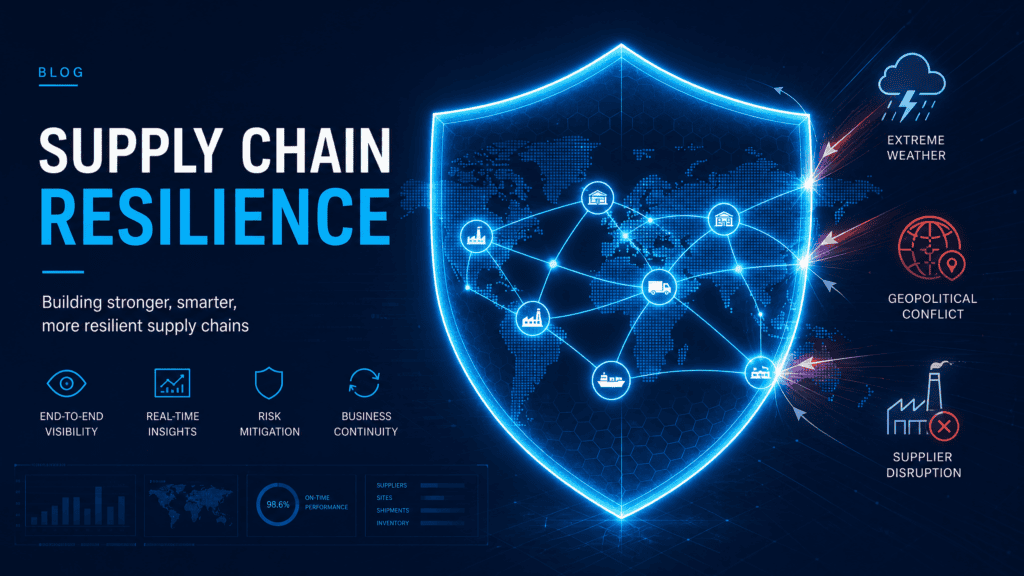
In an increasingly volatile global economy, supply chain stability is no longer a given but a critical competitive advantage. Global crises, geopolitical tensions, and unpredictable market shifts have shown that traditional procurement strategies focused solely on cost efficiency are highly vulnerable. This is where the concept of supply chain resilience comes into play.
This article provides a comprehensive understanding of how companies can build resilient supply chains. It demonstrates how systematic risk management, digital tools, and the use of artificial intelligence—such as the SC-Agent —can help identify and minimize geopolitical and operational risks at an early stage. Through concrete strategies and real-world examples, procurement managers are equipped with the tools they need not only to stabilize their supply chains but also to proactively prepare them for the future.
1. What does “supply chain resilience” mean?
Supply chain resilience describes a supply chain’s ability to absorb unforeseen disruptions, adapt quickly to changing conditions, and return to normal operations rapidly after a crisis—or even emerge from it stronger than before. While traditional supply chain management focused primarily on just-in-time deliveries and maximizing cost savings, resilience places the emphasis on robustness and flexibility.
1.1. The Dimensions of Resilience
Supply chain resilience is not a one-dimensional concept; rather, it encompasses multiple levels that must work together seamlessly. On the one hand, it involves operational resilience—that is, the ability to compensate for short-term disruptions from suppliers or transportation routes through buffer inventories or alternative routes. On the other hand, strategic resilience requires a long-term realignment of procurement markets—for example, through nearshoring or multi-sourcing strategies—to reduce structural dependencies on individual regions.
In addition, financial resilience plays a crucial role. It ensures that the company remains capable of operating even in the face of significant price fluctuations or currency risks. Finally, digital resilience forms the technological backbone: risks can only be identified and assessed in the first place through transparent data, real-time monitoring, and interconnected systems.
1.2. Why Resilience Is Essential Today
The need for resilient supply chains has increased dramatically in recent years. Geopolitical conflicts, such as trade disputes or wars, can disrupt global flows of goods overnight. At the same time, extreme weather events are on the rise, paralyzing production facilities or blocking transportation routes. Regulatory requirements, such as the Supply Chain Due Diligence Act (LkSG), are also forcing companies to make their supply chains more transparent and robust.
Companies that invest in supply chain resilience benefit from more than just greater supply security. They can also respond more quickly to market opportunities, increase customer satisfaction through reliable deliveries, and reduce long-term costs that would otherwise result from production downtime or expensive emergency procurement. According to the German Association for Materials Management, Purchasing, and Logistics (BME), resilience has now become the most important strategic goal in procurement.
2. Strategies for a Crisis-Resilient Supply Chain
To achieve a high level of supply chain resilience, companies must implement proactive strategies that go far beyond traditional risk management. It is not enough to simply react to crises; rather, the supply chain must be designed to absorb disruptions from the outset.
2.1. Multi-Sourcing and Nearshoring
One of the most effective measures for increasing resilience is to move away from single-sourcing. If a company depends on a single supplier for a critical component, that supplier’s failure will inevitably lead to a production shutdown. Multi-sourcing spreads the risk across multiple suppliers, ideally in different geographic regions.
At the same time, nearshoring—that is, shifting procurement to geographically closer regions—is gaining importance. While global supply chains often involve long transport routes and high geopolitical risks, local or regional suppliers enable shorter response times and greater flexibility. This does not signal the end of globalization, but rather a smart diversification of procurement markets.
2.2. Transparency and Supply Chain Mapping
Resilience requires transparency. Companies must not only know their direct suppliers (Tier 1), but also their upstream suppliers (Tier 2, Tier 3) and their locations. This supply chain mapping is essential for uncovering hidden dependencies. Often, several Tier 1 suppliers source their raw materials from the same Tier 2 supplier. If that supplier fails, the entire supply chain is affected, even though the company appeared to have a diversified structure.
Modern software solutions, such as SC-Manager, enable detailed mapping of the supply chain. By integrating data from the ERP system and external sources, a digital twin of the supply chain is created, which makes it possible to precisely identify and assess risks.
3. The Role of AI and the SC Agent
The complexity of modern supply chains can no longer be managed using manual methods or simple spreadsheets. This is where artificial intelligence (AI) comes into play. AI-powered systems can analyze vast amounts of data in real time, identify patterns, and generate accurate forecasts.
3.1. Early Warning Systems and Predictive Analytics
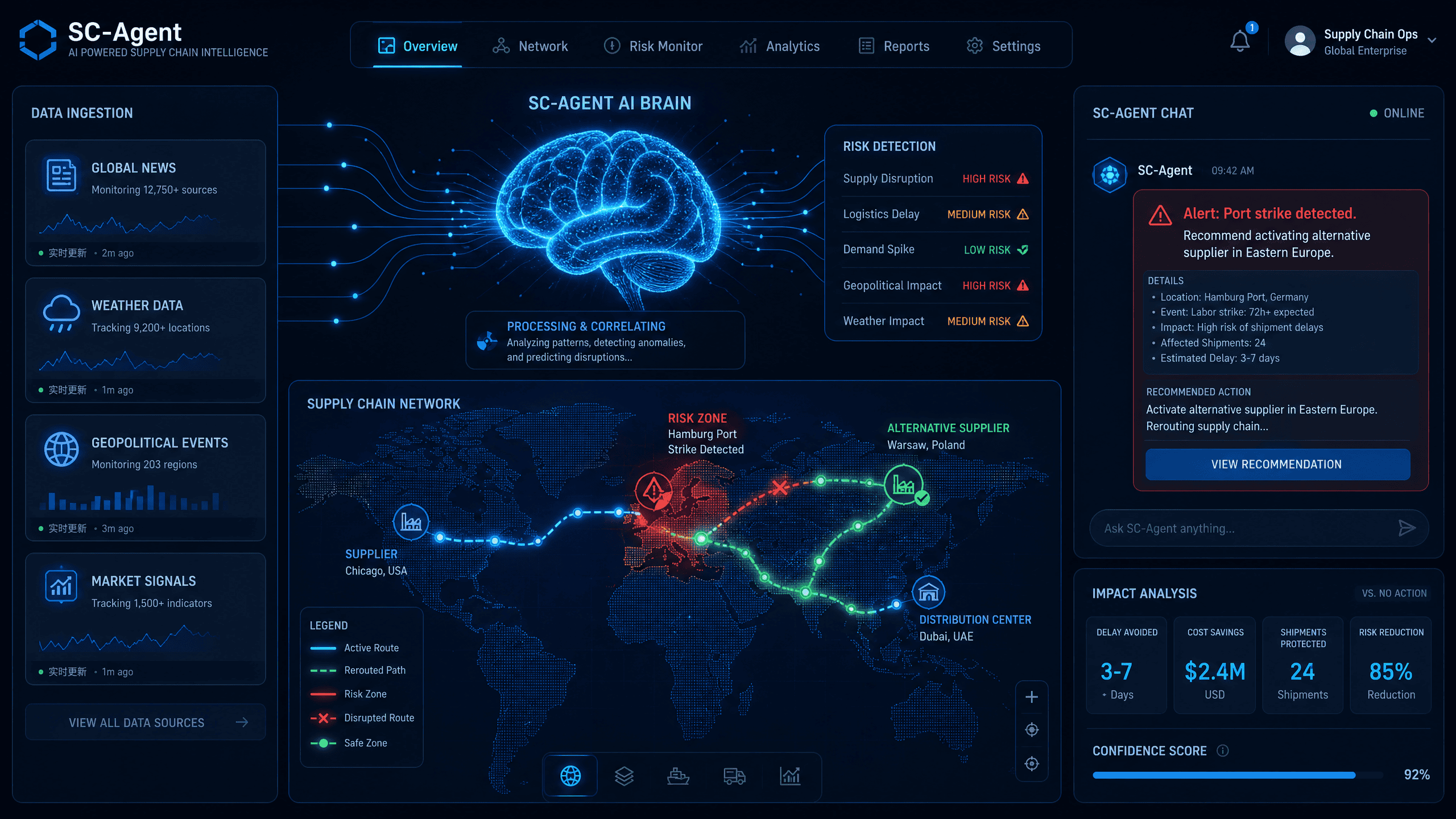
AI-based early-warning systems are a key element of digital resilience. These systems continuously monitor global news, weather data, financial information, and social media feeds to identify potential disruptions early on. Predictive analytics takes it a step further: Based on historical data and current trends, AI calculates the probability of supply disruptions or price fluctuations.
Simmeth System’s SC Agent uses these technologies to proactively support the procurement process. It acts as an intelligent assistant that not only collects data but also interprets it and provides specific recommendations for action. For example, if a strike is looming at a major port, the SC Agent alerts the buyer and automatically suggests alternative transport routes or suppliers.
3.2. The traffic-light system for immediate clarity
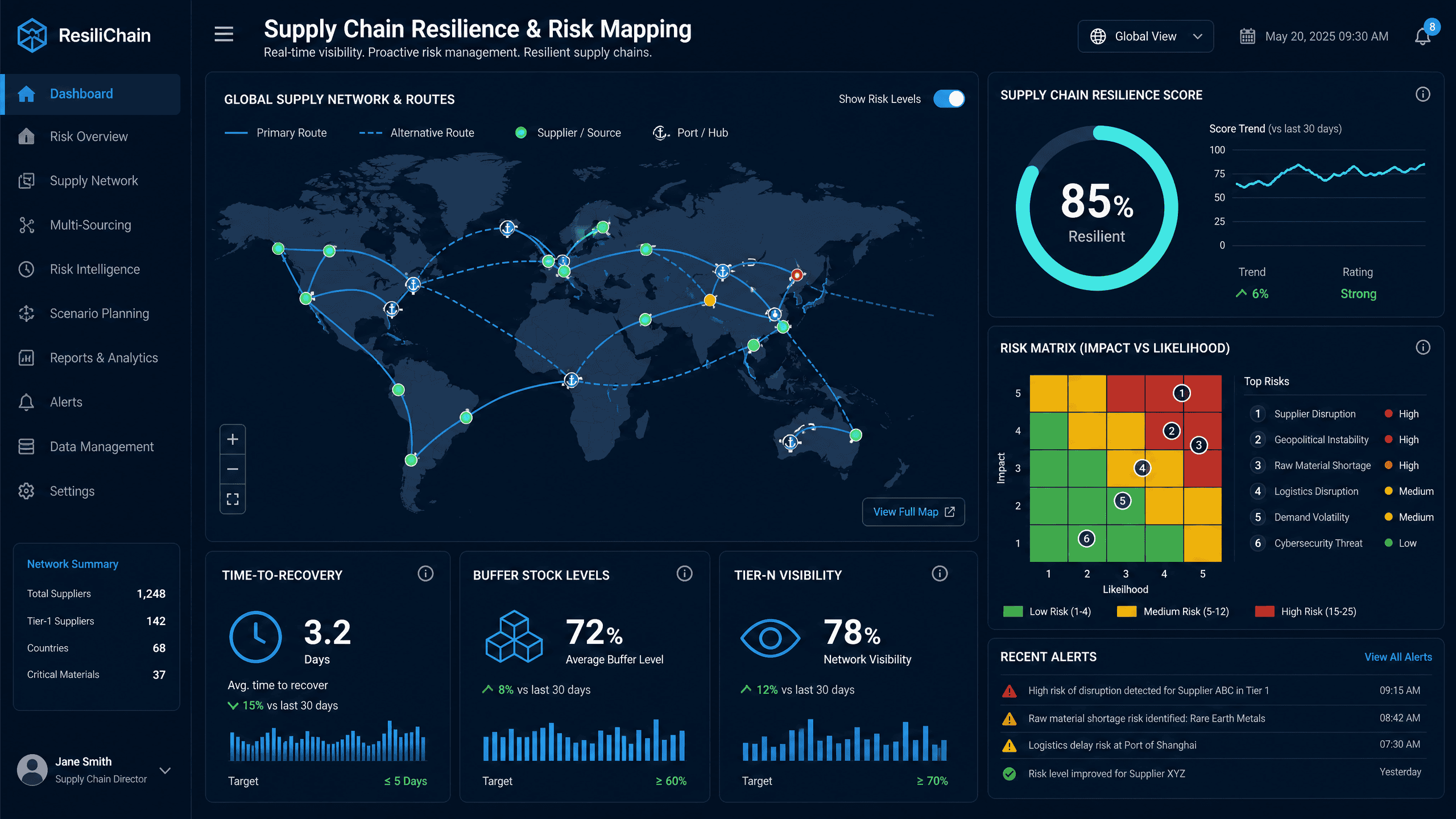
To make the complex risk situation easy to understand intuitively, the SC Manager uses a proven traffic-light system. Every supplier, product category, and item is continuously evaluated and assigned a color code:
- Green: No immediate risk, stable supply.
- Yellow: Increased risk; close monitoring required (e.g., financial instability of the supplier).
- Red: Critical risk, immediate action required (e.g., production shutdown due to a natural disaster).
This visual feedback allows procurement managers to immediately focus their attention on critical areas, rather than having to sift through countless reports. It is a key tool for agile metrics and reporting.
4. Resilience vs. Efficiency: A Necessary Paradigm Shift
For a long time, the paradigm of maximum efficiency prevailed in supply chain management. Inventory levels were minimized, processes were streamlined to the limit, and procurement was shifted to low-wage countries. While this approach reduced costs in the short term, it made supply chains extremely fragile.
4.1. The Value of Buffers and Redundancy
Building supply chain resilience requires a shift in mindset. Companies must accept that resilience comes at a cost—whether through higher inventory levels, qualifying additional suppliers, or investing in digital tools. However, these costs should be viewed as an insurance premium against far more expensive production outages.
Maintaining a strategic buffer stock of critical components or making a deliberate decision to use a slightly more expensive but more reliable local supplier are investments in the company’s stability. The Fraunhofer Institute for Material Flow and Logistics (IML) emphasizes that companies that strike a balance between resilience and efficiency are more successful in the long term.
4.2. Comparison: Traditional vs. Resilient Supply Chain
The following table highlights the key differences between a traditional, efficiency-driven approach and a modern, resilient supply chain:
| Criterion | Traditional Supply Chain (Focus on Efficiency) | Resilient Supply Chain (Focus on Stability) |
| Sourcing Strategy | Single-Sourcing (Focus on Price) | Multi-Sourcing & Nearshoring (Focus on Risk) |
| Warehousing | Just-in-time, minimal inventory | Strategic buffer stocks for critical parts |
| Transparency | Focus on Tier 1 Suppliers | Deep-Tier Mapping (Tier 1 through Tier N) |
| Risk management | Reactive (Fire Department Mode) | Proactive (Predictive Analytics, Early Warning Systems) |
| Technology | Silo solutions, manual processes | Integrated platforms, AI agents, real-time data |
| Supplier relationship | Transactional, price-driven | Partnership-based, collaborative (Supplier Collaboration) |
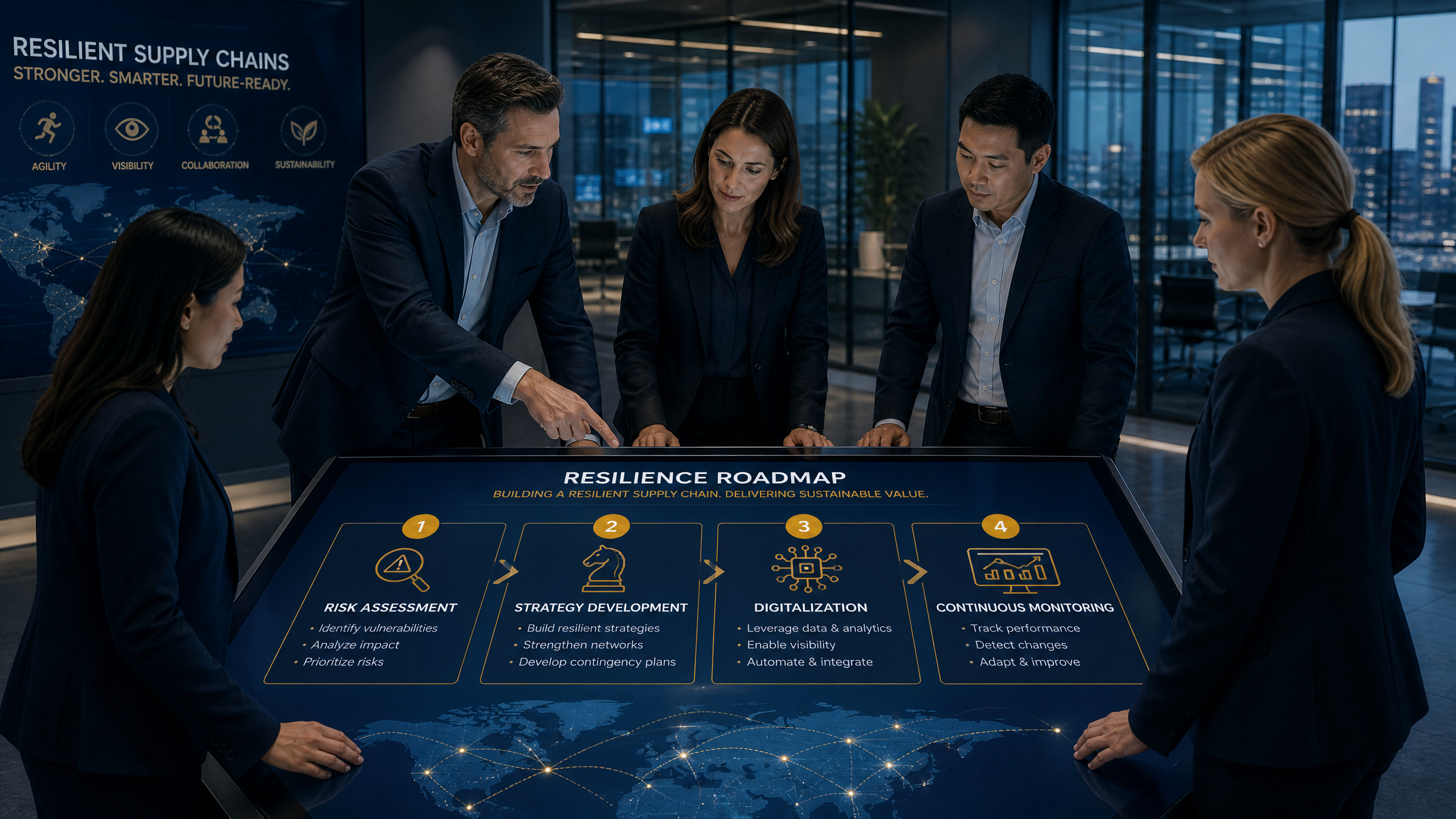
5. Implementation: 4 Steps to a Resilient Supply Chain
The path to a resilient supply chain is an ongoing process that requires strategic planning and the right technological tools.
Step 1: Risk Assessment and Mapping
The first step is to fully map and assess the current supply chain. Which components are critical? Where are there single-sourcing dependencies? Which suppliers are located in geopolitically unstable regions? Detailed supply chain mapping provides the necessary transparency.
Step 2: Strategy Development
Based on the assessment, specific strategies must be developed. This includes identifying alternative suppliers, adjusting the inventory management strategy, and defining contingency plans (business continuity planning).
Step 3: Digitization and Automation
To monitor risks in real time, it is essential to implement an integrated software solution such as SC-Manager. Integration with the ERP system and the use of AI tools such as SC-Agent automate risk monitoring and relieve the procurement department of manual, routine tasks.
Step 4: Continuous Monitoring and Adjustment
Resilience is not a project with a fixed end date, but rather an ongoing task. The risk landscape is constantly changing, which is why the supply chain must be continuously monitored and strategies regularly adjusted. Regular supplier evaluations and audits ensure that partners comply with the required standards.
6. Conclusion: Resilience as a Strategic Success Factor
Supply chain resilience is much more than just a buzzword—it is essential for the survival and success of companies in a complex, unpredictable world. Those who proactively design their supply chains, systematically analyze risks, and leverage modern technologies such as artificial intelligence can turn potential threats into strategic competitive advantages.
With SC Manager and the integrated SC Agent, Simmeth System offers the ideal platform for creating transparency, identifying risks early on, and managing the supply chain with agility. Invest in the resilience of your supply chain today so you’ll be prepared for any challenge tomorrow.
7. FAQ: Frequently Asked Questions About Supply Chain Resilience
1. What is the difference between supply chain resilience and risk management?
Risk management focuses on identifying and assessing specific risks. Supply chain resilience goes beyond that and describes the supply chain’s overall ability to absorb disruptions and recover quickly, even in the face of unforeseeable events.
2. How does artificial intelligence help increase resilience?
AI systems such as the SC-Agent analyze massive amounts of data in real time, identify patterns, and provide early warnings of potential disruptions (e.g., due to weather events or geopolitical tensions). They enable predictive analytics and automated recommendations for action.
3. Is multi-sourcing always better than single-sourcing?
Multi-sourcing significantly reduces the risk of disruption, but is often associated with higher administrative costs and lower economies of scale. For non-critical C-parts, single-sourcing may be appropriate, while for strategically important A-parts, multi-sourcing is essential for resilience.
4. What does nearshoring mean in the context of resilience?
Nearshoring refers to the shift of procurement to geographically closer regions (e.g., Eastern Europe instead of Asia for German companies). This shortens transportation distances, reduces geopolitical risks, and increases supply chain flexibility.
5. How can I measure the resilience of my supply chain?
Key performance indicators (KPIs) for measuring resilience include time-to-recovery (the time it takes to restore delivery capability after a disruption), time-to-survive (the length of time the company can continue production without resupply), and the percentage of critical parts that are multi-sourced.
6. What role does transparency (supply chain mapping) play?
Transparency is the foundation of resilience. Only those who have a complete understanding of their entire supply chain (including Tier 2 and Tier 3 suppliers) can identify hidden dependencies and risks. Detailed mapping reveals vulnerabilities before they become problems.
7. Are resilience and cost-efficiency mutually exclusive?
In the short term, resilience requires investments (e.g., in buffer inventories or software). In the long term, however, it protects against massive costs resulting from production downtime or expensive emergency purchases. A modern supply chain intelligently balances efficiency and resilience.
8. How does the SC Manager’s traffic-light system support resilience?
The traffic-light system continuously evaluates suppliers and product categories based on their risk profile. It provides buyers with an immediate, visual overview (green/yellow/red), allowing them to identify critical situations at a glance and take proactive action.
9. Does the Supply Chain Due Diligence Act (LkSG) affect resilience?
Yes. The transparency and risk analysis required by the LkSG compel companies to gain a better understanding of their supply chains. This not only identifies human rights and environmental risks but also strengthens operational resilience.
10. For which companies is supply chain resilience particularly important?
Resilience is essential for all manufacturing and trading companies. However, it is particularly critical for industries with complex, global supply chains, such as the automotive, mechanical engineering, electronics, and pharmaceutical industries.