



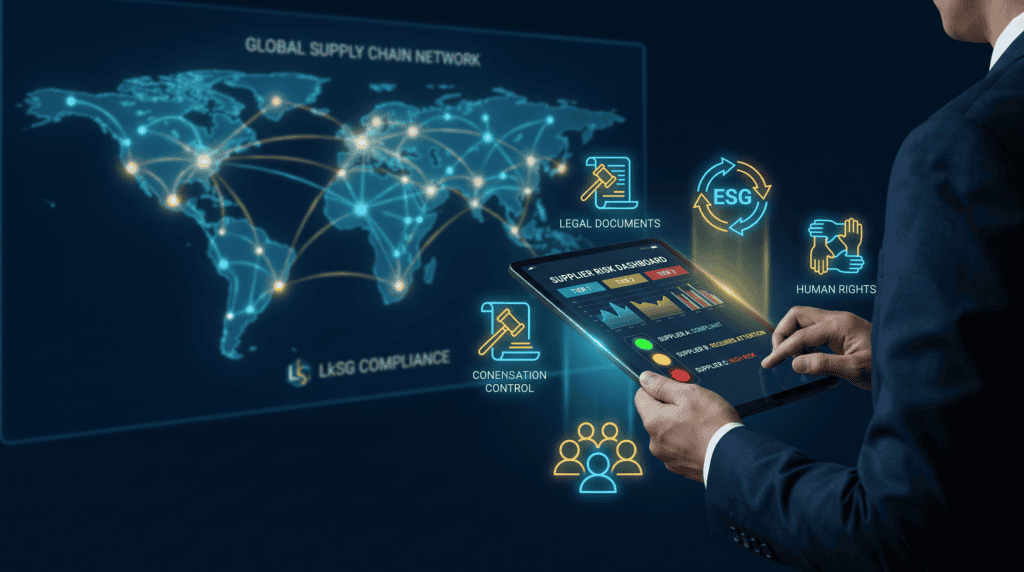
The global economy is closely networked, but this networking not only brings economic benefits, but also immense responsibility. With the entry into force of the Supply Chain Duty of Care Act (LkSG), the German legislator has created a clear framework to protect human rights and environmental standards along global supply chains. For companies, this means a paradigm shift: from voluntary corporate social responsibility (CSR) to binding, legally enforceable due diligence obligations.
In this comprehensive guide, we shed light on all aspects of the LkSG – from the definition and the legal text to specific obligations such as risk analysis and practical implementation with modern software such as SC-Manager.
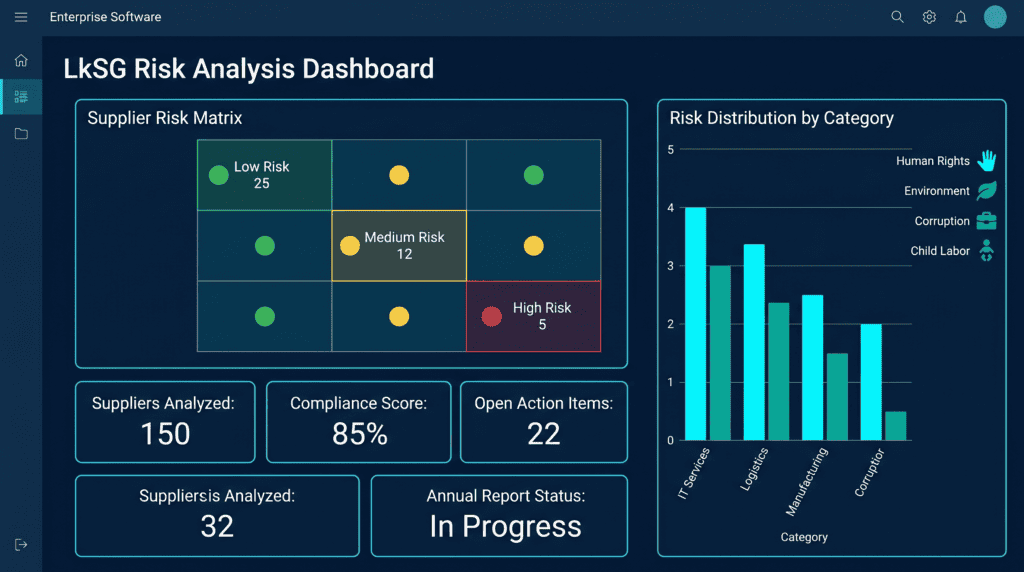
Figure 1: The six phases of supplier lifecycle management – from onboarding to development
What is the Supply Chain Due Diligence Act?
The Supply Chain Due Diligence Act marks a historic milestone in German business legislation. It obliges companies above a certain size to take responsibility for compliance with human rights and environmental standards in their global supply chains.
Definition of the Supply Chain Due Diligence Act
The Supply Chain Due Diligence Act (officially: Act on Corporate Due Diligence in Supply Chains) is a German federal law that obliges companies to identify and assess human rights and environmental risks in their supply chains and to minimize or eliminate them through appropriate preventive and remedial measures. It aims to prevent exploitation, child labor, forced labor and serious environmental degradation in global procurement markets.
Difference between LkSG and Supply Chain Act
In public debate and in the media, the terms “LkSG” and “Lieferkettengesetz” are often used interchangeably. From a technical point of view, “Lieferkettensorgfaltspflichtengesetz” (LkSG) is the correct, official legal term in Germany. The term “Lieferkettengesetz” is the colloquial shortened form.
In addition, the German LkSG must be distinguished from the European Supply Chain Directive (CSDDD – Corporate Sustainability Due Diligence Directive), which is often referred to as the “EU Supply Chain Act” and must be transposed into national law in the coming years.
Background and objectives of the LkSG Act
The background to the law lies in the realization that voluntary commitments by companies were not sufficient to effectively prevent human rights violations in global supply chains. Tragedies such as the collapse of the Rana Plaza textile factory in Bangladesh have increased the political pressure. The German government’s National Action Plan for Business and Human Rights (NAP), which is based on the UN Guiding Principles on Business and Human Rights, also showed that voluntary measures were not enough – which ultimately led to the LkSG.
The main objective of the LkSG is to protect basic human rights and selected environmental goods. It is intended to ensure that companies that generate profits in Germany do not profit from human rights violations abroad. At the same time, the law creates legal certainty and a level playing field for all affected companies in Germany.
Supply Chain Act Germany
In an international context, the law is often referred to as the “Supply Chain Act Germany” or the “German Supply Chain Due Diligence Act” (GSCA). This term is crucial for internationally operating companies and foreign suppliers, as the German law also has a massive impact on suppliers outside Germany that are part of the supply chain of a company based in Germany.
LkSG legal text and official documents
Precise knowledge of the legal basis is essential for legally compliant implementation. The law is clearly structured and precisely defines the obligations of companies.
LkSG legal text and paragraphs
The legal text of the LkSG is divided into several sections. The most important paragraphs include:
- § 1 Scope of application: Defines which companies are covered by the law.
- § 2 Definitions: Clarifies key terms such as “supply chain”, “human rights risk” and “environmental risk”.
- § 3 Due diligence obligations: Lists the core duties (risk management, risk analysis, preventive measures).
- § 4 Risk management: Requires the establishment of an effective risk management system.
- § 5 Risk analysis: Describes the obligation to analyze the supply chain regularly and on an ad hoc basis.
- § 8 Complaints procedure: Obligation to establish an internal complaints mechanism.
- § Section 10 Documentation and reporting: regulates the transparency obligations towards the authority and the public.
Explanatory memorandum and official sources of the LkSG
The official explanatory memorandum provides important interpretation aids for interpreting the paragraphs. The Federal Office of Economics and Export Control (BAFA) is responsible for monitoring and enforcing the LkSG. The BAFA regularly publishes handouts, FAQs and guidelines that support companies with practical implementation and serve as the primary official source alongside the legal text itself.

Figure 2: A modern SLM dashboard provides real-time visibility of supplier performance, risks and global supplier locations
Scope of application of the LkSG
One of the most frequently asked questions in practice is: Who actually has to apply the law and how far does the responsibility in the supply chain extend?
Who is affected by the Supply Chain Due Diligence Act?
The LkSG came into force in two stages:
-Since January 1, 2023: Companies with their head office, principal place of business, administrative headquarters or registered office in Germany and generally at least 3,000 employees in Germany.
-Since January 1, 2024: The threshold has generally fallen to at least 1,000 employees in Germany.
Foreign companies are also affected if they have a branch office in Germany and employ the corresponding number of employees there.
Obligations for suppliers and subsidiaries
In the supply chain, the law distinguishes between the company’s own business division, direct suppliers (Tier 1) and indirect suppliers (Tier N).
While the obligations in the company’s own business area and with direct suppliers apply in full, companies only have to take action with indirect suppliers if they obtain “substantiated knowledge” of possible infringements.
Important for SMEs: Even if small and medium-sized enterprises (SMEs) are not directly covered by the law, they are indirectly affected as suppliers (trickle-down effect). Large companies pass on the requirements of the LkSG to their suppliers via contractual assurances (Code of Conduct).
Rights and obligations in the Supply Chain Due Diligence Act
The LkSG does not require companies to guarantee that no human rights violations occur in their supply chains (no obligation to succeed), but rather an obligation to make efforts. They must prove that they have established appropriate systems to minimize risks.
Reporting obligations according to LkSG
Companies must prepare an annual report on the fulfillment of their due diligence obligations in the previous financial year. This report must be made publicly available free of charge on the company website no later than four months after the end of the financial year (for at least seven years) and submitted electronically to BAFA. The report must outline which risks have been identified, which measures have been taken and how the effectiveness of these measures is assessed.
Risk analysis in the Supply Chain Due Diligence Act // LkSG risk analysis
The LkSG risk analysis is at the heart of the law. Companies must carry out an appropriate risk analysis at least once a year as well as on an ad hoc basis (e.g. when introducing new products or entering new markets).
In doing so, human rights and environmental risks in the company’s own business area and at direct suppliers must be identified, weighted and prioritized. The results of the risk analysis must be communicated internally to the relevant decision-makers (e.g. the Management Board) and form the basis for all further preventive and remedial measures.
This is where the immense value of software solutions becomes apparent: The SC Agent in SC Manager automates this risk analysis by continuously monitoring external databases, messages and sanctions lists and visualizing risks in real time in a traffic light system.
Human Rights Officer at the LkSG
The law requires the definition of an internal responsibility for monitoring risk management. This role is often referred to as the “Human Rights Officer”. This person or department must report directly to the management and be equipped with the necessary resources and powers to enforce compliance with due diligence obligations within the company.
Supply Chain Due Diligence Act | Implementation and practice
Putting the theoretical requirements of the law into practice presents many companies with major organizational and technical challenges.
Supply Chain Due Diligence Act Software
Manually monitoring hundreds or thousands of suppliers using Excel lists is neither efficient nor legally compliant in the context of the LkSG. Modern supply chain due diligence software is essential.
The SC-Manager from Simmeth System offers a dedicated Risk & Compliance module for this purpose. The solution enables:
-Automated risk analyses: The integrated SC agent collects AI-supported data from global sources.
-Supplier portal: Automated dispatch and evaluation of LkSG questionnaires via the supplier portal.
Real-time dashboards: Visual control using the tried-and-tested traffic light system (green/yellow/red).
-Measures management: Seamless documentation of preventive and corrective measures as part of supplier development.
-FBAFA-compliant reporting: automatic generation of the required reports at the touch of a button.
ESG and supply chain law
The LkSG is closely linked to the broader topic of ESG (Environmental, Social, Governance). While the LkSG defines specific human rights and environmental obligations, ESG reporting under the CSRD (Corporate Sustainability Reporting Directive) requires even greater transparency about a company’s sustainability performance. A clean LkSG database, as established in the SC-Manager, is the perfect foundation for all other ESG reporting obligations.
Examples of the implementation of LkSG in companies
Successful companies integrate the LkSG deeply into their procurement processes:
1.Automotive industry: Manufacturers use automated audits and supplier assessments to continuously monitor raw material suppliers (e.g. for cobalt or lithium).
2.textile industry: companies establish digital grievance mechanisms that are also accessible to workers in production facilities in Asia via smartphone in the local language.
3. mechanical engineering: SMEs use AI agents to carry out an automated risk check (sanctions lists, press screening) immediately when a new supplier is created in the ERP system.
Supply Chain Due Diligence Act | Criticism and discussion
Like any far-reaching law, the LkSG is the subject of intense and controversial debate.
Supply chain law pros and cons
| Pro (advantages) | Contra (challenges) |
| Human rights protection: Effective leverage against exploitation and child labor. | Bureaucracy: High administrative burden, especially for SMEs. |
| Legal certainty: Clear guidelines instead of confusing voluntary initiatives. | Competitive disadvantage: Fear of disadvantages compared to companies from countries without such laws. |
| Reputation protection: Avoiding scandals and loss of image. | Trickle-down effect: burden on SMEs that are not actually covered by the law. |
| Resilience: Better knowledge of the supply chain leads to more stable procurement processes. | Liability risks: Fear of civil lawsuits and high fines. |
Points of criticism of the Supply Chain Due Diligence Act
Business associations such as the DIHK (Association of German Chambers of Industry and Commerce) often criticize the high bureaucratic burden and the lack of clarity regarding undefined legal terms (e.g. “appropriate measures”). There is also criticism that German companies are held responsible for misconduct by suppliers on the other side of the world, over which they often have only limited influence. NGOs such as Amnesty International, on the other hand, sometimes criticize that the law does not go far enough and that civil liability regulations are missing.
Supply Chain Due Diligence Act 2025 | Current status
In 2025, many companies will be focusing on consolidating their LkSG processes and preparing for the European Supply Chain Directive (CSDDD). The Federal Ministry of Labor and Social Affairs (BMAS), which was responsible for the LkSG, provides up-to-date information and implementation aids. The CSDDD will tighten the requirements of the German LkSG in some areas (e.g. inclusion of the downstream part of the value chain, civil liability) and extend the scope of application to even more companies in the long term. Companies that digitize their processes today with systems such as SC-Manager are optimally prepared for these upcoming European tightening measures.

Figure 4: Successful SLM implementation follows a clear roadmap – from analysis and software selection to go-live
LkSG Further information
To ensure compliance, companies need practical tools and reliable sources of information.
Supply Chain Due Diligence Act Checklist
- A basic checklist for LkSG implementation includes:
- Adopt a policy statement on the human rights strategy.
- Appoint a human rights officer.
- Carry out an annual and event-related risk analysis.
- Establish prevention measures in our own business area and with suppliers.
- Define remedial measures in the event of detected violations.
- Set up a complaints procedure.
- Ensure documentation and annual reporting.
Examples and guidelines in the Supply Chain Due Diligence Act
The BAFA offers numerous industry-specific guidelines and best practice examples on its website. Trade associations such as the BME also provide their members with valuable sample documents (e.g. for the Supplier Code of Conduct).
Relevant links to LkSG PDF and online sources
- Official BAFA information page on the LkSG
- Legal text LkSG on buzer.de (complete paragraph text)
- Fraunhofer IML: Research into sustainable supply chains
- VDMA: LkSG guidelines for mechanical engineering
- Gabler Wirtschaftslexikon: Definition of the Supply Chain Due Diligence Act
Key Takeaways
- The Supply Chain Due Diligence Act (LkSG) obliges companies to observe human rights and environmental standards in global supply chains.
- The law will come into force in two phases: from 2023 for companies with at least 3,000 employees and from 2024 for those with 1,000 employees.
- Companies must carry out risk analyses and establish preventive measures to minimize human rights risks.
- The LkSG ensures legal certainty and a level playing field, but also indirectly affects smaller suppliers through contractual requirements.
- Software solutions such as the SC-Manager efficiently support companies in implementing the LkSG through automation and real-time reporting.
FAQ – Frequently asked questions about the LkSG
1. when does the Supply Chain Due Diligence Act apply?
The law came into force on January 1, 2023 for companies with at least 3,000 employees. Since January 1, 2024, it has also applied to companies with at least 1,000 employees in Germany.
2. are small and medium-sized enterprises (SMEs) also affected by the LkSG?
SMEs are not directly obliged by law. However, they are indirectly affected (trickle-down effect), as large, reporting companies must contractually pass on the requirements to their suppliers (i.e. also SMEs).
3. what are the penalties for violating the LkSG?
BAFA can impose fines and penalties for violations. These can amount to up to 8 million euros or, for companies with an annual turnover of over 400 million euros, up to 2 percent of the global average annual turnover. There is also the threat of exclusion from public procurement.
4. what is the difference between LkSG and CSDDD?
The LkSG is the German national law. The CSDDD (Corporate Sustainability Due Diligence Directive) is the European directive that has yet to be transposed into national law. The CSDDD goes further than the LkSG in some respects, e.g. through the introduction of civil liability and the inclusion of parts of the downstream value chain.
5. how often must a risk analysis be carried out?
The risk analysis must be carried out at least once a year and on an ad hoc basis. There is cause, for example, when a company launches new products, enters new markets or obtains substantiated knowledge of possible legal infringements by indirect suppliers.
6. do I have to check my entire supply chain down to the raw material?
No. The proactive obligations (such as regular risk analysis) primarily relate to the company’s own business area and direct suppliers (Tier 1). In the case of indirect suppliers (Tier N), companies only have to take action on an ad hoc basis if they receive “substantiated knowledge” of possible breaches.
7 How does software help with the implementation of the LkSG?
Software such as SC-Manager automates data collection via supplier portals, carries out AI-supported risk analyses, visualizes risks in real-time dashboards (traffic light system) and generates the legally required reports at the touch of a button. This drastically reduces manual effort.
8 What must a complaints procedure under the LkSG achieve?
The grievance procedure must enable people (both employees and external third parties in the supply chain) to report human rights or environmental risks or violations. It must be confidential, accessible and transparent.
9 What is a declaration of principles within the meaning of the LkSG?
The policy statement is a public document from the management in which the company sets out its human rights strategy. It must contain the results of the risk analysis and clearly formulate the expectations of the company’s own employees and suppliers.
10. can I delegate responsibility to my suppliers?
No. Although companies can obtain contractual assurances (e.g. Code of Conduct) from their suppliers, the legal responsibility for carrying out the risk analysis and taking preventive measures remains with the reporting company.