



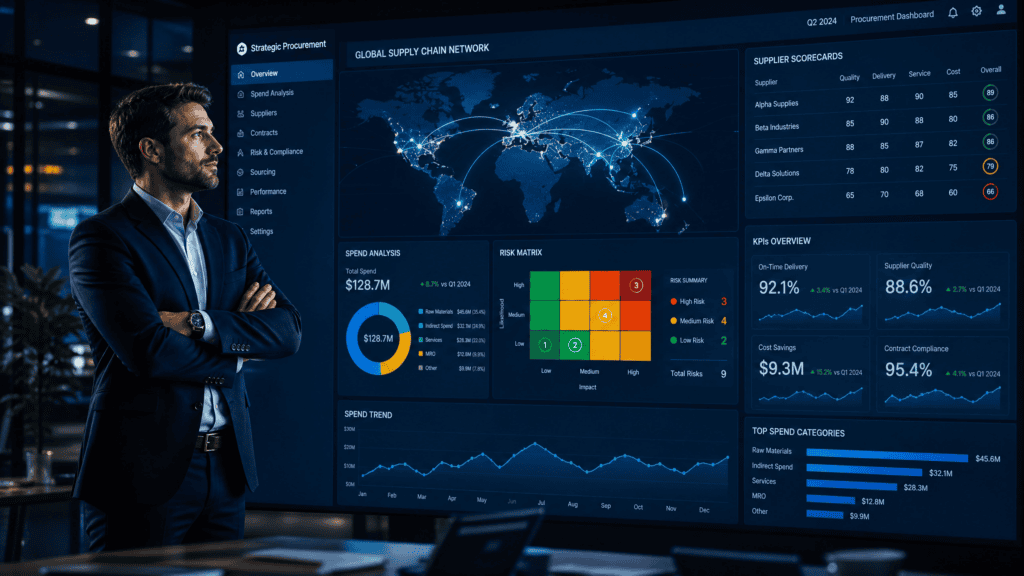
In an increasingly volatile and globalized business world, the role of procurement has changed fundamentally. Purchasing is no longer just an administrative ordering department, but has developed into a central value driver for companies. Strategic purchasing is at the heart of this transformation. It forms the foundation for long-term competitive advantages, resilient supply chains and sustainable cost reductions.
This comprehensive guide sheds light on all facets of strategic purchasing – from the definition and core tasks to the job description of the strategic buyer, modern purchasing strategies and the ongoing digitalization through AI-supported systems such as SC Manager.
What is strategic purchasing?
Strategic procurement encompasses all long-term, planning and controlling activities in a company’s procurement system. While simply covering demand only closes short-term bottlenecks, strategic procurement aims to proactively shape the value chain by systematically analyzing procurement markets and building sustainable supplier relationships in a targeted manner.
The definition of strategic purchasing goes far beyond mere price negotiations. It is about holistically optimizing the total cost of ownership (TCO), ensuring security of supply, promoting innovation through suppliers and minimizing risks. Strategic purchasing acts as an interface between internal specialist departments (such as production, R&D and sales) and external procurement markets. According to the German Association of Materials Management, Purchasing and Logistics (BME), an excellently positioned strategic purchasing department is a decisive factor for the profitability and innovative strength of a company today.
Tasks in strategic purchasing
The tasks in strategic purchasing are varied and require a high degree of analytical thinking and market understanding. The central activities include
- Procurement market research: Continuous analysis of global and local markets to identify new suppliers, technologies and price trends.
- Supplier management: Systematic selection, supplier evaluation and supplier development to build strategic partnerships.
- Category management: Structuring the procurement volume into homogeneous product groups and developing specific strategies for each category.
- Risk management: Identification and proactive management of supply chain risks, particularly in the context of the German Supply Chain Duty of Care Act (LkSG).
- Contract and price negotiations: Conclusion of framework agreements and long-term agreements to secure optimal conditions.
- Process optimization: Continuous improvement of procurement processes and implementation of digital tools.
Strategic Buyer – Profile, Role & Qualifications
The job profile in strategic purchasing has become highly professionalized. Today, the strategic buyer acts as an internal consultant, market analyst and relationship manager.
What does a strategic buyer do?
A strategic buyer spends less time placing orders and more time analyzing data, developing strategies and communicating with stakeholders. They conduct complex negotiations, audit suppliers on site, assess risks and work closely with product development to optimize costs and integrate innovations as early as the design phase (early supplier involvement).
What skills does a strategic buyer need?
The requirements for a successful strategic buyer are demanding. In addition to a sound business or technical degree (e.g. industrial engineering), the following skills are crucial:
- Analytical skills: Confident with big data, TCO analysis and metrics & reporting.
- Negotiation skills: Confident demeanor and the ability to create win-win situations.
- Intercultural competence: understanding of global markets and different business cultures.
- Technical understanding: Ability to understand specifications and production processes.
- IT affinity: Confident handling of ERP systems and modern e-procurement solutions.
Further training in strategic purchasing
As requirements are constantly changing, continuous further training in strategic procurement is essential. Professional associations and institutes offer specialized certificate courses, for example to become a “Certified Procurement Manager”. Topics such as sustainability (ESG), AI applications in procurement and agile project management are becoming increasingly important.
Strategic purchasing process
The strategic purchasing process is a structured, cyclical process that ensures that procurement decisions are data-based and targeted. A proven model comprises the following phases:
- Needs analysis: What is required? Which specifications are mandatory?
- Market analysis: Which suppliers are there worldwide? How are prices and availability developing?
- Strategy development: Determination of the procurement strategy (e.g. single sourcing vs. multiple sourcing) for the respective product group.
- Supplier selection: Execution of tenders (RfX), bid evaluation and negotiation.
- Conclusion of contracts: Fixing framework agreements, SLAs (Service Level Agreements) and KPIs.
- Implementation: Transfer of the negotiated conditions to operational purchasing.
- Performance measurement: Continuous monitoring of supplier performance and initiation of improvement measures.
Purchasing strategies & strategic purchasing methods
Successful purchasing departments use a variety of strategies and methods to achieve their goals. The choice of the right purchasing strategy depends heavily on the respective product group and the market situation.
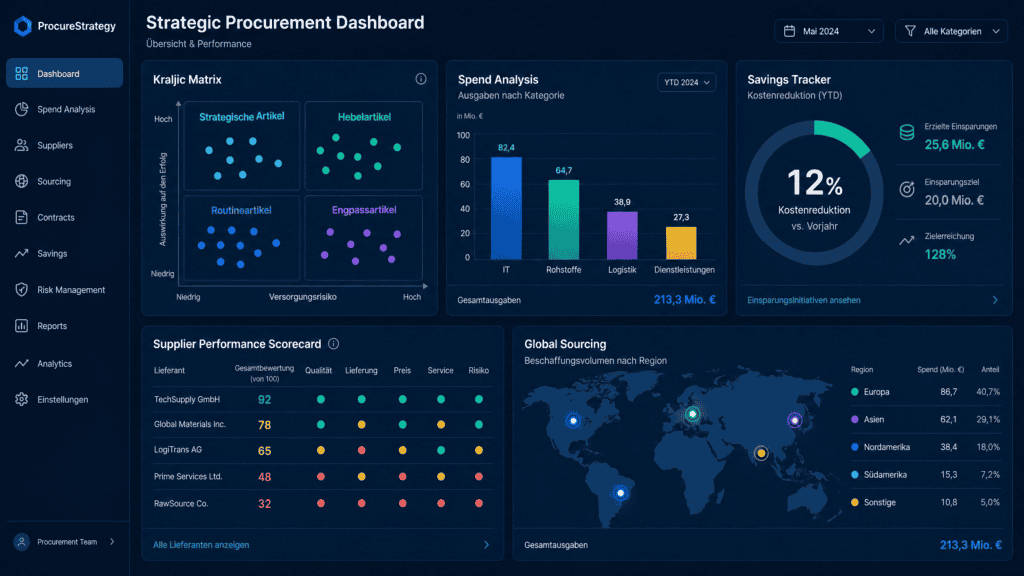
A classic tool is the Kraljic matrix, which divides procurement goods into four categories according to their supply risk and their impact on the company’s results:
- Strategic articles: High risk, high influence (focus: building partnerships).
- Leverage article: Low risk, high influence (focus: use competition, lower prices).
- Bottleneck article: High risk, low impact (focus: secure supply, look for alternatives).
- Routine articles: Low risk, low impact (focus: minimize process costs, automation).
Other examples of purchasing strategies are global sourcing (worldwide procurement to reduce costs), local sourcing (local procurement for greater flexibility and sustainability) or modular sourcing (procurement of complete assemblies instead of individual parts).
Strategic purchasing in the industry
Strategic purchasing plays a particularly important role in the manufacturing industry, as material costs often account for more than 50% of sales. In the industrial environment, the focus is strongly on ensuring production supply (just-in-time/just-in-sequence), quality assurance and close integration with supply chain management.
Research institutes such as the Fraunhofer IML emphasize that industrial companies that digitalize their strategic procurement and network it closely with production are significantly more resilient to global disruptions.
Structure & organization of strategic purchasing
The structure of strategic purchasing varies depending on the size of the company and the industry. In modern organizations, strategic purchasing is often strictly separated from operational purchasing in order to give strategic purchasers the necessary freedom for conceptual work.
A matrix organization is often found: buyers are organized according to product groups (category management) on the one hand and assigned to specific business units or projects on the other. A central purchasing department (lead buyer concept) bundles requirements across different locations in order to achieve economies of scale.
Strategic purchasing: consulting & optimization
Many companies recognize that their purchasing potential has not yet been fully exploited and call in external consulting for strategic purchasing. The aim of such optimization projects is often to restructure the purchasing organization, sharpen product group strategies or drive forward digitalization.
Successful optimization usually begins with a detailed spend analysis in order to create transparency about the procurement volume and identify potential savings (quick wins).
Digitalization in strategic purchasing
Digitalization is the biggest lever for increasing efficiency in strategic purchasing. Modern software solutions such as the SC Manager from Simmeth System transform procurement from a reactive to a proactive function.
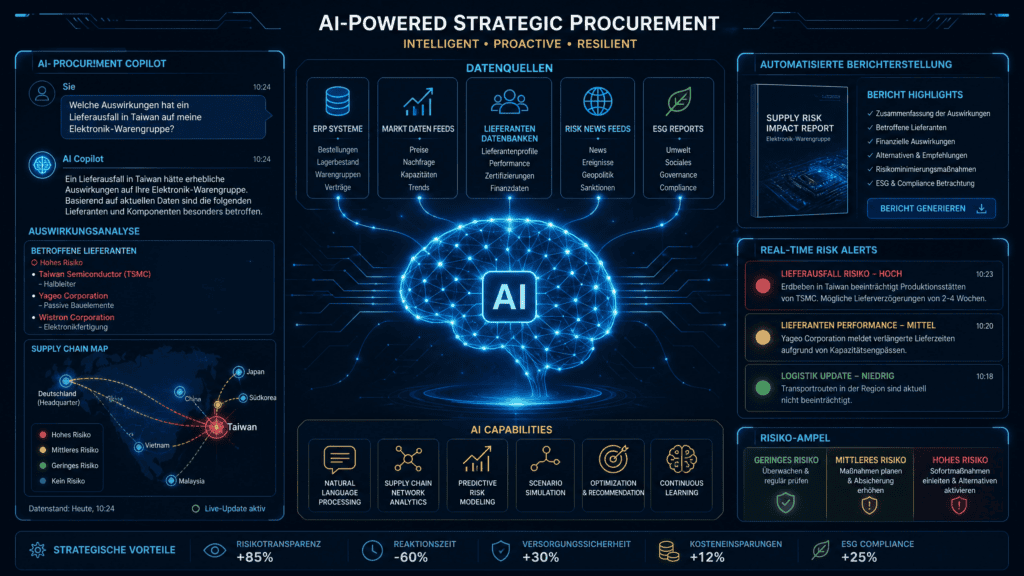
A central element of this is the use of artificial intelligence. The integrated SC agent (a communicative AI) enables buyers to interact with their data in natural language. Instead of laboriously compiling reports, the buyer can ask: “What strategic impact will a delivery failure in Taiwan have on my electronics product group?” The AI agent analyses the data in real time and visualizes the risks in a clear traffic light system (green/yellow/red).
Supplier portals also enable seamless supplier collaboration, in which documents, certificates and forecasts are exchanged digitally and automatically.
Strategies for sustainable procurement
Sustainability (ESG) is no longer a niche topic, but a core requirement for strategic procurement. Driven by legal requirements such as the LkSG and the expectations of customers and investors, purchasing strategies must integrate environmental and social criteria.
Sustainable procurement means not only evaluating suppliers based on price and quality, but also checking their carbon footprint, working conditions and environmental management (e.g. in accordance with ISO 14001). Strategic procurement is responsible for creating transparency in the supply chain (supply chain traceability) and actively supporting suppliers in improving their sustainability performance.
Strategic vs. operational purchasing
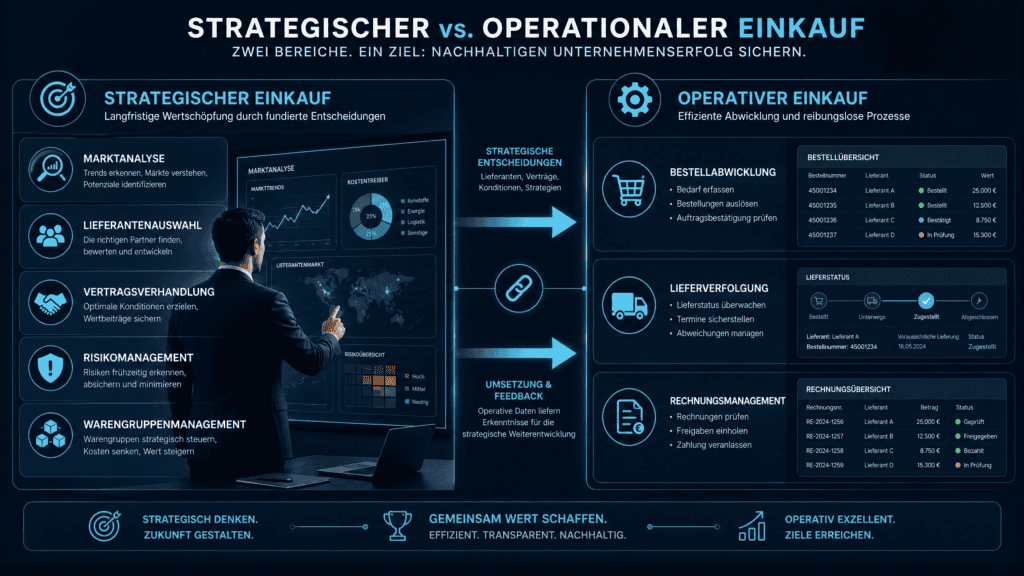
In order to fully understand the role of strategic purchasing, it is essential to differentiate it from operational purchasing. While strategic purchasing creates the framework conditions, operational purchasing carries out the daily transactions.
| Criterion | Strategic purchasing | Operational purchasing |
| Focus | Long-term value creation, strategy, TCO | Short-term demand coverage, transactions |
| Time horizon | Medium to long-term (months to years) | Short-term (days to weeks) |
| Core tasks | Market analysis, supplier selection, contract negotiation | Order initiation, deadline tracking, invoice verification |
| Goals | Optimize cost structure, minimize risks, promote innovation | Ensure security of supply, reduce process costs |
| Tools | Spend analysis, risk management tools, AI agents | ERP systems, e-catalogs, automated ordering systems |
| Interaction | Management, R&D, strategic suppliers | Specialist departments, scheduling, operational supplier contacts |
A clear separation of these two areas is crucial. If strategic buyers are tied up in day-to-day operations (e.g. clarifying delivery delays), they do not have the time for value-adding strategic tasks.
Conclusion: The importance of strategic purchasing for companies
Strategic procurement is an indispensable success factor for modern companies. It not only reduces costs in the long term, but also ensures innovative strength, minimizes supply chain risks and drives the sustainability transformation.
To fully exploit this potential, strategic buyers need the right tools. AI-supported solutions such as the SC Manager and the intelligent SC Agent give purchasing departments the transparency and automation they need to free themselves from administrative tasks and focus on what really matters: Strategically shaping supplier relationships and securing the company’s future.
FAQ – Frequently asked questions about the LkSG
1. what is the difference between strategic and operational purchasing?
Strategic purchasing deals with long-term goals, market analyses, supplier selection and contract negotiations. Operational purchasing takes care of day-to-day business: order initiation, deadline tracking and invoice verification. Strategic purchasing creates the framework within which operational purchasing operates.
2. what are the most important tasks in strategic purchasing?
The core tasks include procurement market research, supplier management (selection, evaluation, development), product group management, risk management and the negotiation of framework agreements and prices.
3. what qualifications does a strategic buyer need?
A strategic buyer needs strong analytical skills, negotiation skills, intercultural competence, technical understanding and an affinity for IT. A business or technical degree often forms the basis.
4. what is the salary in strategic purchasing?
The salary of a strategic buyer varies depending on the industry, company size and professional experience. In Germany, the average gross annual salary is often between 60,000 and 85,000 euros, although managers (e.g. purchasing managers) can earn well over 100,000 euros.
5 What is a purchasing strategy?
A purchasing strategy is a long-term plan that defines how a company achieves its procurement goals. Examples include global sourcing (worldwide procurement), single sourcing (concentration on one supplier) or multiple sourcing (risk diversification across several suppliers).
6 Why is digitalization so important in strategic procurement?
Digitalization creates transparency regarding expenditure (spend analysis), automates routine tasks and enables data-based decisions. AI-supported systems can also monitor risks in real time and process complex data volumes for the buyer.
7 How does strategic purchasing support sustainability (ESG)?
Strategic Purchasing selects suppliers according to ecological and social criteria, requests certificates (e.g. ISO 14001) and ensures compliance with laws such as the German Supply Chain Duty of Care Act (LkSG).
8 What is category management in purchasing?
Category management is the structuring of the entire procurement volume into logical, homogeneous groups (e.g. IT hardware, C-parts, raw materials). A specific, market-compliant purchasing strategy is developed for each product group.
9 How do you measure success in strategic purchasing?
Success is measured using key performance indicators (KPIs). Important KPIs include cost savings, supplier quality (error rate), delivery reliability and the proportion of strategically managed purchasing volume (spend under management).
10 Why should strategic purchasing be separated from operational purchasing?
Separation ensures that strategic buyers are not “lost” in day-to-day operations (e.g. dunning). Only then do they have the necessary capacity for market analyses, strategy development and the establishment of long-term supplier partnerships.