Sustainability has long since ceased to be merely a marketing issue; it is now a strict regulatory requirement and a key value driver for companies. Strategic procurement is at the heart of this development, as the majority of a company’s environmental and social impacts do not arise from its own production but deep within the supply chain. This is where the ESG (Environmental, Social, Governance) concept comes into play in procurement.
This article provides a comprehensive understanding of how procurement managers can integrate sustainability into their procurement processes and make it measurable. It highlights the implications of current guidelines such as the CSRD (Corporate Sustainability Reporting Directive) and demonstrates how digital systems—such as SC-Manager —help track Scope 3 emissions, evaluate suppliers, and systematically achieve ESG goals.
1. What does ESG mean in procurement?
The acronym ESG stands for Environmental, Social, and Governance. In the context of purchasing, this means that suppliers and procurement processes are no longer evaluated solely based on traditional criteria such as price, quality, and on-time delivery, but also based on their sustainability performance.
1.1. The Three Pillars of Sustainability
The Environmental Pillar focuses on the ecological impacts of the supply chain. These include the carbon footprint (particularly Scope 3 emissions), resource consumption, waste management, and compliance with environmental standards such as ISO 14001. Green procurement aims to systematically minimize these environmental impacts.
The social pillar (social issues) examines working conditions and human rights throughout the supply chain. Issues such as fair wages, workplace safety, the prohibition of child and forced labor, and diversity are central to this pillar. In Germany, these aspects are primarily regulated by the Supply Chain Due Diligence Act (LkSG).
The governance pillar (corporate governance) refers to suppliers’ ethical and transparent management practices. This includes combating corruption and bribery, adhering to compliance guidelines, and maintaining transparent reporting structures.
1.2. Why ESG Is Indispensable Today
The pressure on companies to operate sustainably is coming from several directions. On the one hand, investors and customers are increasingly demanding transparent and sustainable products. On the other hand, lawmakers are tightening regulations significantly. While the LkSG and the European CSDDD (EU Supply Chain Due Diligence Directive) primarily regulate due diligence obligations, the CSRD (Corporate Sustainability Reporting Directive) requires companies to report in detail on their sustainability performance.
According to the German Association for Materials Management, Purchasing, and Logistics (BME), implementing ESG criteria has become one of the biggest challenges for procurement departments. Those who fail to take proactive action in this area risk not only hefty fines, but also damage to their reputation and exclusion from important tenders.
2. The CSRD and Its Impact on Procurement
The Corporate Sustainability Reporting Directive (CSRD) is a milestone in European sustainability reporting. It will gradually require approximately 50,000 companies in the EU to prepare detailed sustainability reports in accordance with the European Sustainability Reporting Standards (ESRS).
2.1. The Focus on the Value Chain
A key aspect of the CSRD is that companies must report not only on their own activities, but also on the material impacts, risks, and opportunities throughout their entire value chain. This directly affects procurement. In the future, buyers will need to request detailed data from their suppliers in order to meet their own company’s reporting obligations.
Tracking Scope 3 emissions is particularly challenging. While Scope 1 (direct emissions) and Scope 2 (indirect emissions from purchased energy) are relatively easy to determine, Scope 3 emissions encompass all other indirect emissions in the upstream and downstream supply chain. For manufacturing companies, Scope 3 emissions often account for over 80% of their total carbon footprint.
2.2. Distinction: LkSG, CSDDD, and CSRD
The multitude of regulatory requirements often leads to confusion. The following table distinguishes between the three most important guidelines for purchasing:
| Criterion | LkSG (Germany) | CSDDD (EU) | CSRD (EU) |
| Focus | Due Diligence Obligations (Human Rights & Environment) | Due Diligence Obligations (Human Rights & Environment) | Sustainability Reporting (ESG) |
| Goal | Mitigating Risks in the Supply Chain | Mitigating Risks in the Supply Chain | Transparency and Comparability of ESG Data |
| Affected Companies | 1,000 or more employees | For companies with 1,000 or more employees and revenue of €450 million or more | All large companies and capital-market-oriented SMEs |
| Relevance for Purchasing | Risk Analysis, Prevention, Remediation | Risk Analysis, Prevention, Climate Plan | Data Collection (Scope 3, Supplier KPIs) |
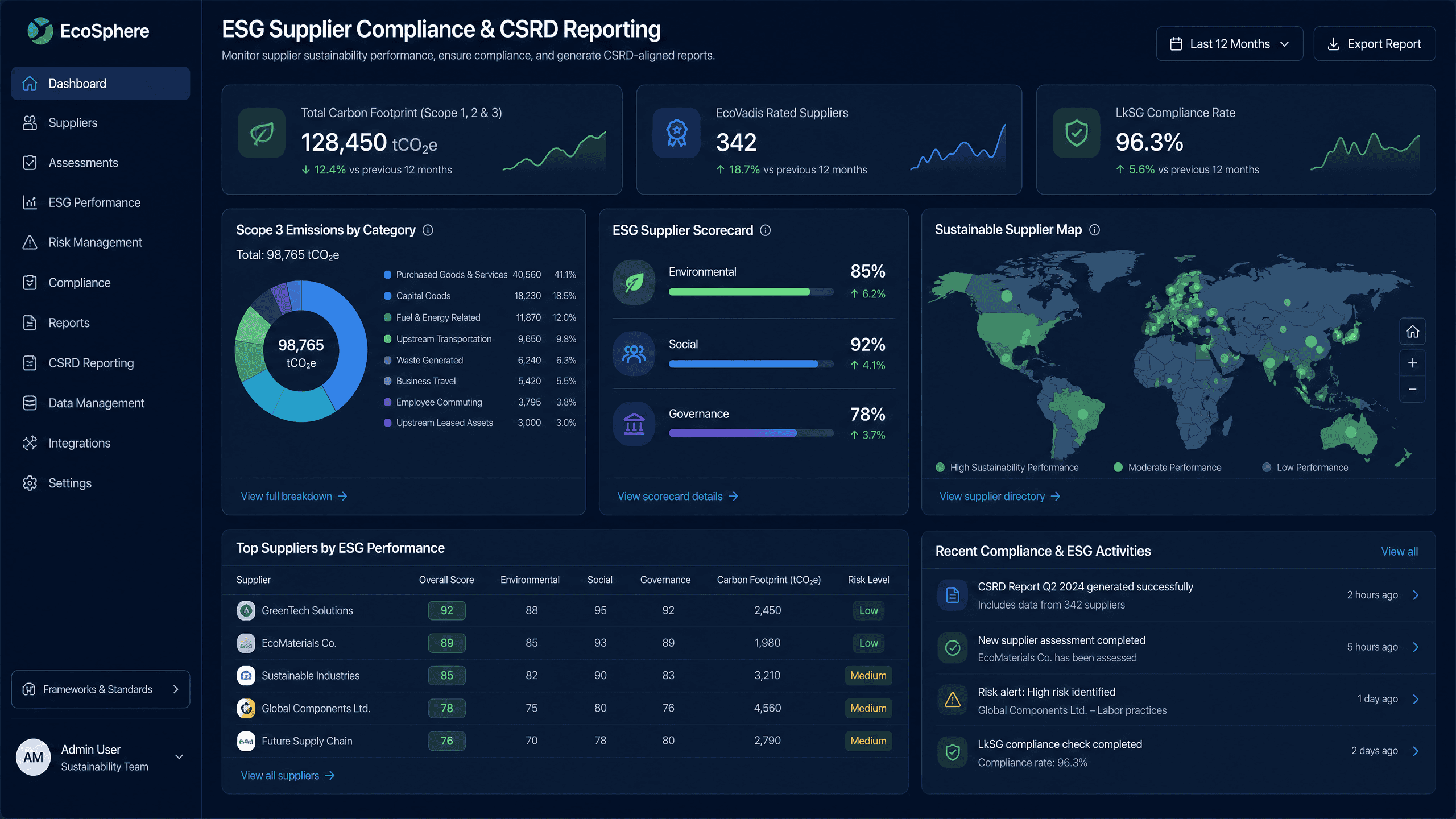
3. Collect ESG data and make it measurable
The biggest challenge in implementing ESG in procurement is data collection. How can companies collect and analyze reliable sustainability data from hundreds or thousands of suppliers worldwide?
3.1. Supplier Onboarding and Questionnaires
The foundation for measurable sustainability is laid as early as the supplier onboarding process. New suppliers should complete a detailed ESG questionnaire from the outset and upload the relevant certificates (e.g., ISO 14001, SA8000).
A modern supplier portal automates this process. Suppliers can update their data on their own, while the system monitors the validity of certificates and automatically sends reminders when they expire. This ensures that the ESG database is always up to date.
3.2. Integration of External ESG Ratings
Since self-reported information from suppliers is often insufficient or difficult to verify, many companies turn to external ESG rating agencies (such as EcoVadis or IntegrityNext). These agencies evaluate suppliers’ sustainability performance based on standardized criteria.
The SC Manager enables the seamless integration of such external ratings via API interfaces. The rating results are directly incorporated into the supplier evaluation and displayed on the dashboard. This allows buyers to immediately see how sustainably a potential supplier operates whenever they make an award decision.
4. The Role of AI and the SC Agent
Manually evaluating ESG questionnaires, certificates, and sustainability reports is extremely time-consuming and prone to errors. This is where the use of artificial intelligence offers enormous potential.
4.1. Automated Document Review
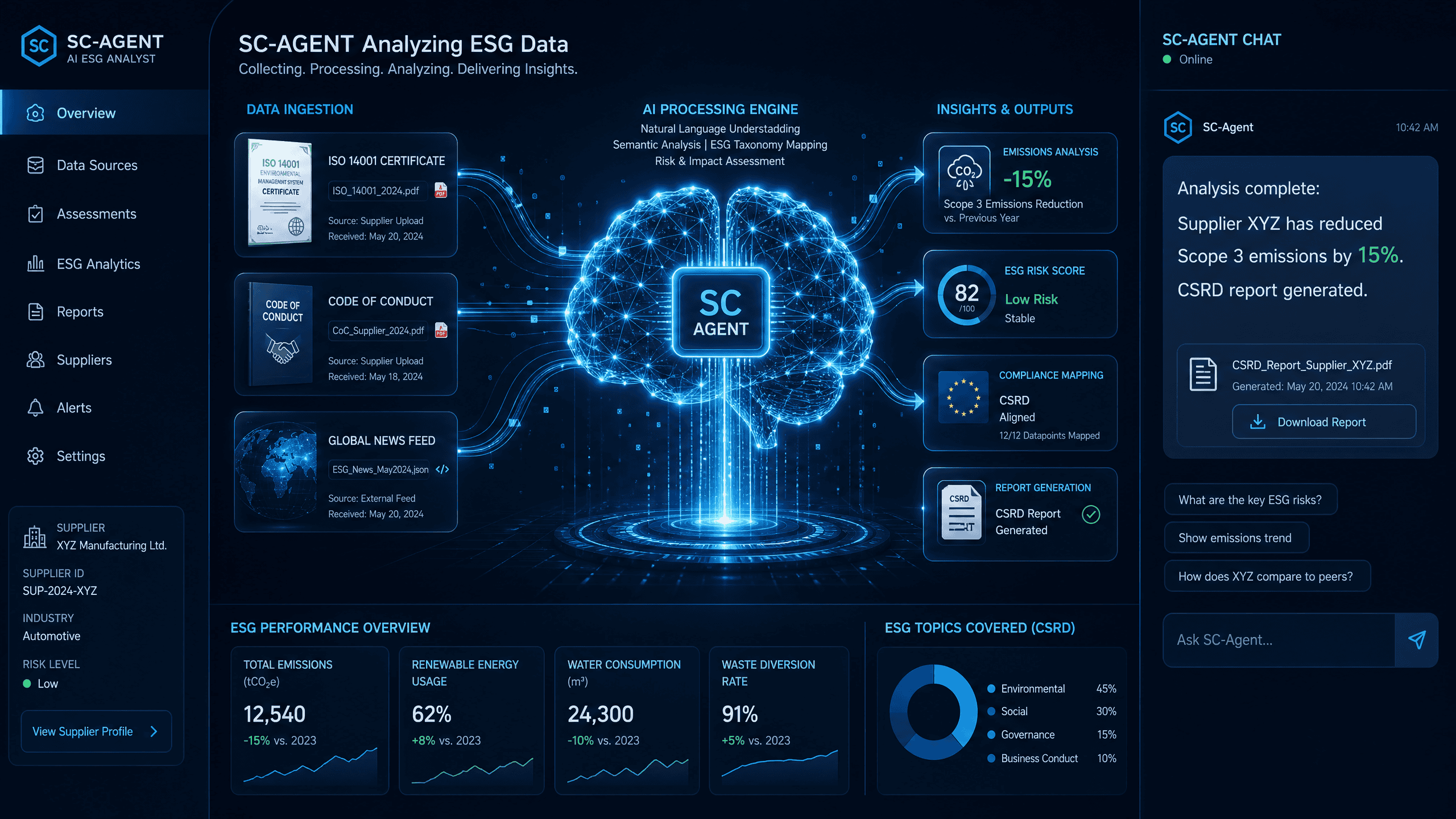
AI-powered systems can automatically parse uploaded documents (e.g., codes of conduct, environmental certifications) and verify that they are complete and consistent with the company’s own policies. This significantly speeds up the review process and relieves the procurement department of routine administrative tasks.
4.2. The SC Agent as an ESG Assistant
Simmeth System’s SC Agent serves as an intelligent assistant for ESG management. It continuously monitors global news sources, NGO reports, and sanctions lists to identify potential ESG violations in the supply chain at an early stage.
In addition, the SC Agent enables communicative data analysis. For example, a buyer might ask, “Which of our top 20 suppliers have not yet submitted a Scope 3 emissions report?” or “Which suppliers in Asia pose a high risk of human rights violations?” The SC Agent provides immediate, precise answers and generates corresponding reports upon request.
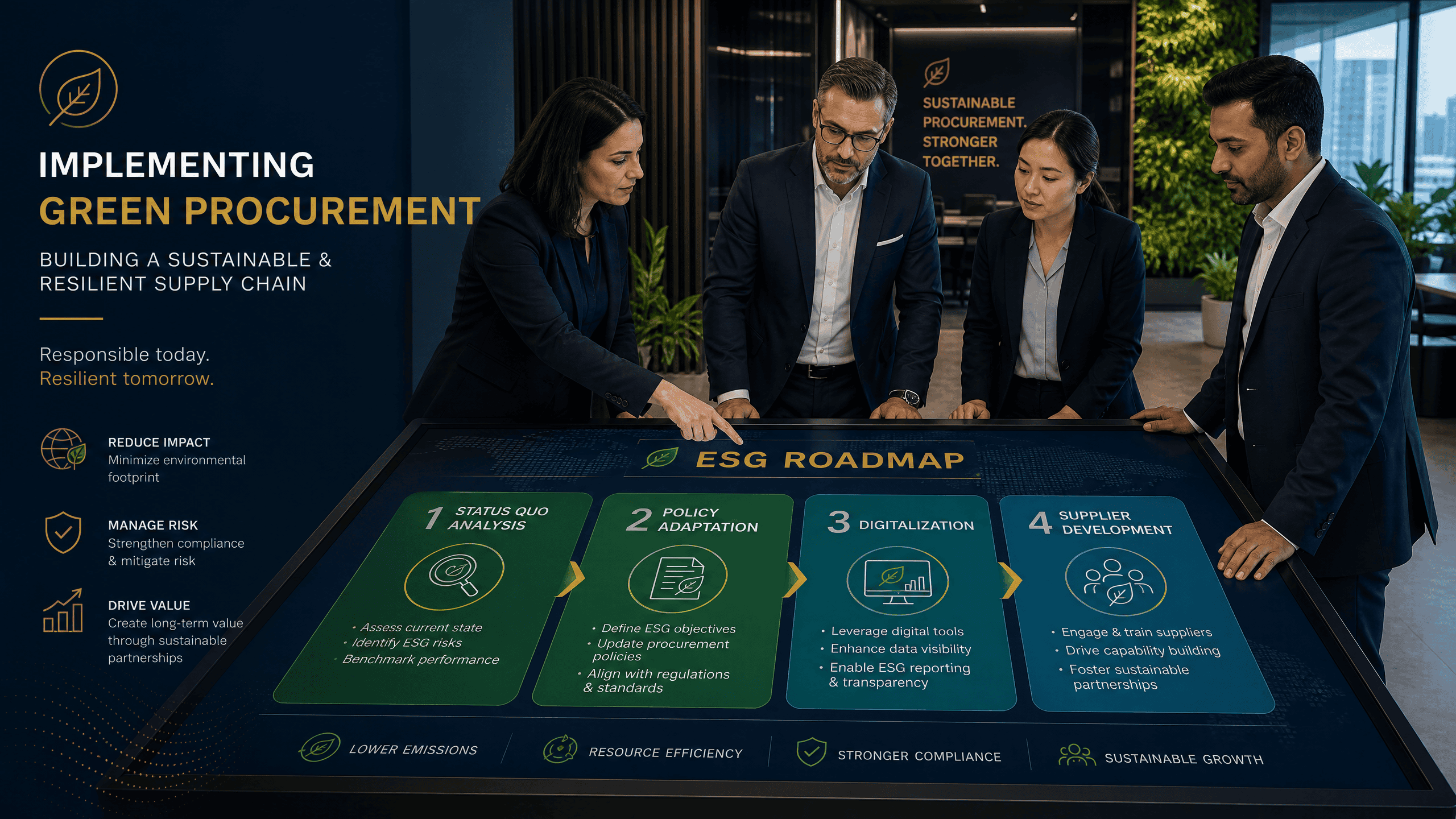
5. Implementation: 4 Steps to Green Procurement
Integrating ESG criteria into procurement is a strategic transformation process. The following roadmap shows how companies can approach this process in a structured manner.
Step 1: Analysis of the Current Situation and Goal Setting
First, it is necessary to determine where the company currently stands. What ESG data is already available? What regulatory requirements (LkSG, CSRD) must be met? Based on this, specific, measurable goals are defined (e.g., “Reduce Scope 3 emissions by 20% by 2030”).
Step 2: Revising the Procurement Guidelines
ESG goals must be incorporated into procurement policies and the Supplier Code of Conduct. Sustainability must become a procurement criterion on par with price and quality.
Step 3: Digitization and Data Collection
Implementing a software solution such as SC-Manager is essential for managing the flood of data. Self-declarations and certificates are obtained through the supplier portal, while external ratings are integrated via interfaces. The Key Metrics & Reporting module visualizes ESG performance in real time.
Step 4: Supplier Development and Collaboration
Sustainability is not achieved through mere oversight, but through collaborative partnerships. If suppliers do not yet meet ESG requirements, targeted supplier development measures should be implemented. These can range from training to joint projects aimed at reducing CO2 emissions.
6. Conclusion: ESG as a Strategic Opportunity
Integrating ESG criteria into procurement undoubtedly requires effort, but it also offers enormous strategic opportunities. Companies that make their supply chains sustainable and transparent not only minimize regulatory risks but also strengthen their reputation, retain environmentally conscious customers and investors, and increase their supply chain resilience in the long term.
With SC-Manager and the integrated SC-Agent, Simmeth System offers the ideal platform for efficiently collecting ESG data, comprehensively evaluating suppliers, and confidently meeting the complex requirements of the CSRD and LkSG. Make sustainability measurable and transform your procurement into a driver of sustainable value creation.
7. FAQ: Frequently Asked Questions About ESG in Procurement
1. What does ESG mean in the context of procurement?
ESG stands for Environmental, Social, and Governance. In procurement, this means that suppliers are evaluated not only on price and quality, but also on their sustainability performance (e.g., CO2 emissions, working conditions, compliance).
2. How does the CSRD affect procurement?
The CSRD (Corporate Sustainability Reporting Directive) requires companies to provide detailed sustainability reporting. Since a large portion of environmental impacts originate in the supply chain, the procurement department must require its suppliers to provide detailed ESG data (particularly Scope 3 emissions).
3. What are Scope 3 emissions?
Scope 3 emissions include all indirect greenhouse gas emissions generated in a company’s upstream and downstream value chain (e.g., during raw material extraction, transportation, or the use of the products sold). For manufacturing companies, these emissions often account for the largest portion of their carbon footprint.
4. How does the LkSG differ from the CSRD?
The LkSG (Supply Chain Due Diligence Act) focuses on actively preventing human rights and environmental risks in the supply chain (due diligence obligations). The CSRD, on the other hand, is purely a reporting directive that requires transparency regarding the company’s overall ESG performance.
5. How can I collect ESG data from my suppliers?
The most efficient method is to use a digital supplier portal. Here, suppliers can complete standardized ESG questionnaires and upload certificates. In addition, external ESG ratings (e.g., EcoVadis) can be integrated into the supplier evaluation via interfaces.
6. What role does artificial intelligence play in ESG?
AI systems such as the SC-Agent can automatically review documents, monitor global news for ESG violations, and perform complex data analyses. They relieve the procurement department of manual, routine tasks and enable proactive risk management.
7. What happens if a supplier does not meet the ESG criteria?
Immediate exclusion is often not the best solution. Instead, the goal should be to work with suppliers to help them improve. Together, corrective action plans are defined to gradually improve the supplier’s sustainability performance.
8. How do I weigh ESG criteria when selecting suppliers?
The weighting depends on the company’s strategy. Best practices show that ESG criteria are increasingly being factored into the overall evaluation (alongside price, quality, and logistics) at a rate of 10% to 20% in order to achieve a genuine steering effect.
9. Is green procurement relevant only to large corporations?
No. Even though SMEs often do not fall directly under the CSRD or the LkSG, they are indirectly affected as suppliers to large corporations (trickle-down effect). Large corporations are increasingly requiring ESG data from their SME suppliers.
10. How does the SC Manager support ESG implementation?
SC Manager offers an integrated platform for comprehensive ESG management: from supplier onboarding to the integration of external ratings and automated risk monitoring via SC Agent, all the way to interactive dashboards for CSRD reporting.