



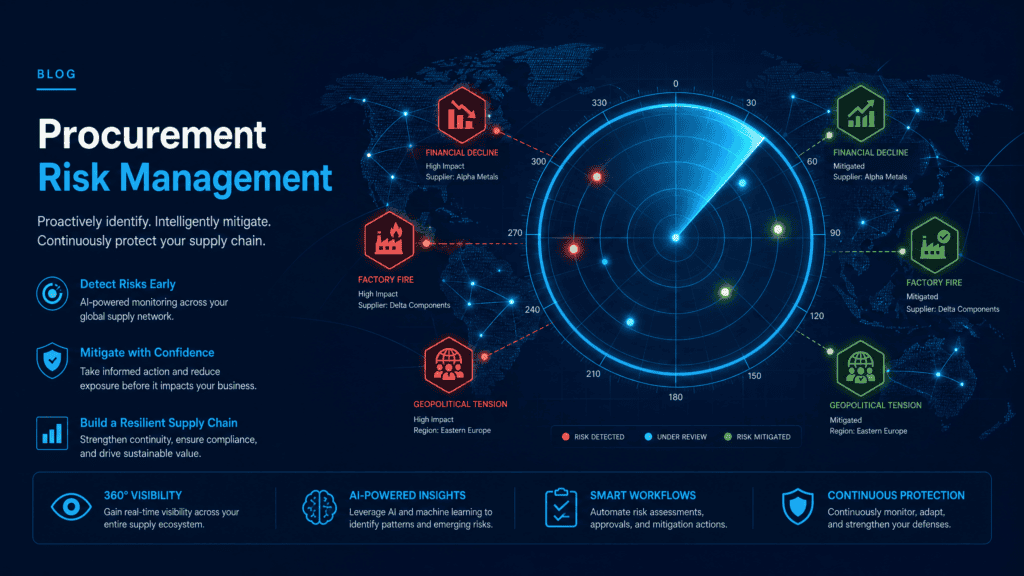
In a globalized economy, the procurement function is no longer merely responsible for sourcing goods at the best price. It has become the key guardian of the stability of the entire supply chain. Today, an undetected risk at a seemingly insignificant supplier can bring entire production lines to a standstill. This is precisely where systematic risk management in procurement comes into play.
This article explores how companies can systematically identify, assess, and manage supplier risks. It explains why traditional, reactive approaches are no longer effective and how modern, AI-powered tools—such as SC-Manager with its integrated SC-Agent—establish a proactive early-warning system. With practical methods and a clear implementation guide, procurement managers are equipped with the tools they need to secure their supply chains.
1. Why Risk Management Is Essential in Procurement
Risk management in procurement (supplier risk management) is the systematic process of identifying, assessing, and mitigating risks arising from suppliers or the procurement environment. While the focus used to be primarily on financial risks—such as a supplier’s insolvency—the range of risks has expanded significantly today.
1.1. The Dimensions of Supplier Risk
Modern procurement networks face a wide range of risk factors:
•Operational risks: Production outages at suppliers, quality issues, or logistics bottlenecks.
•Financial risks: risk of insolvency, currency fluctuations, or sharp increases in commodity prices.
•Geopolitical risks: trade conflicts, tariffs, wars, or political instability in procurement markets.
•Compliance and ESG risks: Violations of the Supply Chain Due Diligence Act (LkSG), environmental pollution, or corruption.
•Cyber Risks: Hacker attacks on suppliers that result in data loss or production stoppages.
1.2. From a Reactive to a Proactive Approach
Traditionally, the procurement department often operated reactively: a problem would arise, and the team would try to limit the damage through emergency purchases (firefighting). In today’s world, this approach is not only inefficient but also threatens the company’s very existence.
Modern risk management takes a proactive approach. It anticipates disruptions before they occur and puts preventive measures in place. According to the German Association for Materials Management, Purchasing, and Logistics (BME), implementing early-warning systems is the most important strategy for increasing supply chain resilience.
2. Methods for Risk Identification and Assessment
In order to manage risks, they must first be systematically identified and assessed. Various methods have been established for this purpose in strategic procurement.
2.1. The Risk Matrix (Impact vs. Likelihood)
The standard tool for risk assessment is the risk matrix. Each identified risk is evaluated based on two criteria:
1. Probability of Occurrence (Likelihood): What is the chance that the risk will occur?
2. Extent of Damage (Impact): How significant would the financial or operational damage be if the risk were to materialize?
Multiplying these two values yields the risk priority number (RPN). Risks with a high probability and a high severity of damage fall into the red quadrant of the matrix and require immediate countermeasures.
2.2. The Kraljic Matrix from a Risk Perspective
The classic Kraljic Matrix segments procurement items based on their impact on the company’s bottom line and the procurement market risk. The “Strategic Items” quadrant (high impact, high risk) is particularly relevant for risk management. Here, close supplier relationships and detailed contingency plans are essential.
But even items subject to supply shortages (low impact, high risk) should not be underestimated. A missing microchip costing just a few cents can prevent the shipment of an expensive end product.
2.3. FMEA (Failure Mode and Effects Analysis)
FMEA is an analytical method for identifying potential sources of failure in products or processes at an early stage. In procurement, it is used to scrutinize the processes of critical suppliers. This involves not only assessing how likely a failure is and how severe the consequences would be, but also how likely it is that the failure will be detected in time.
3. Digital Tools and the Traffic Light System
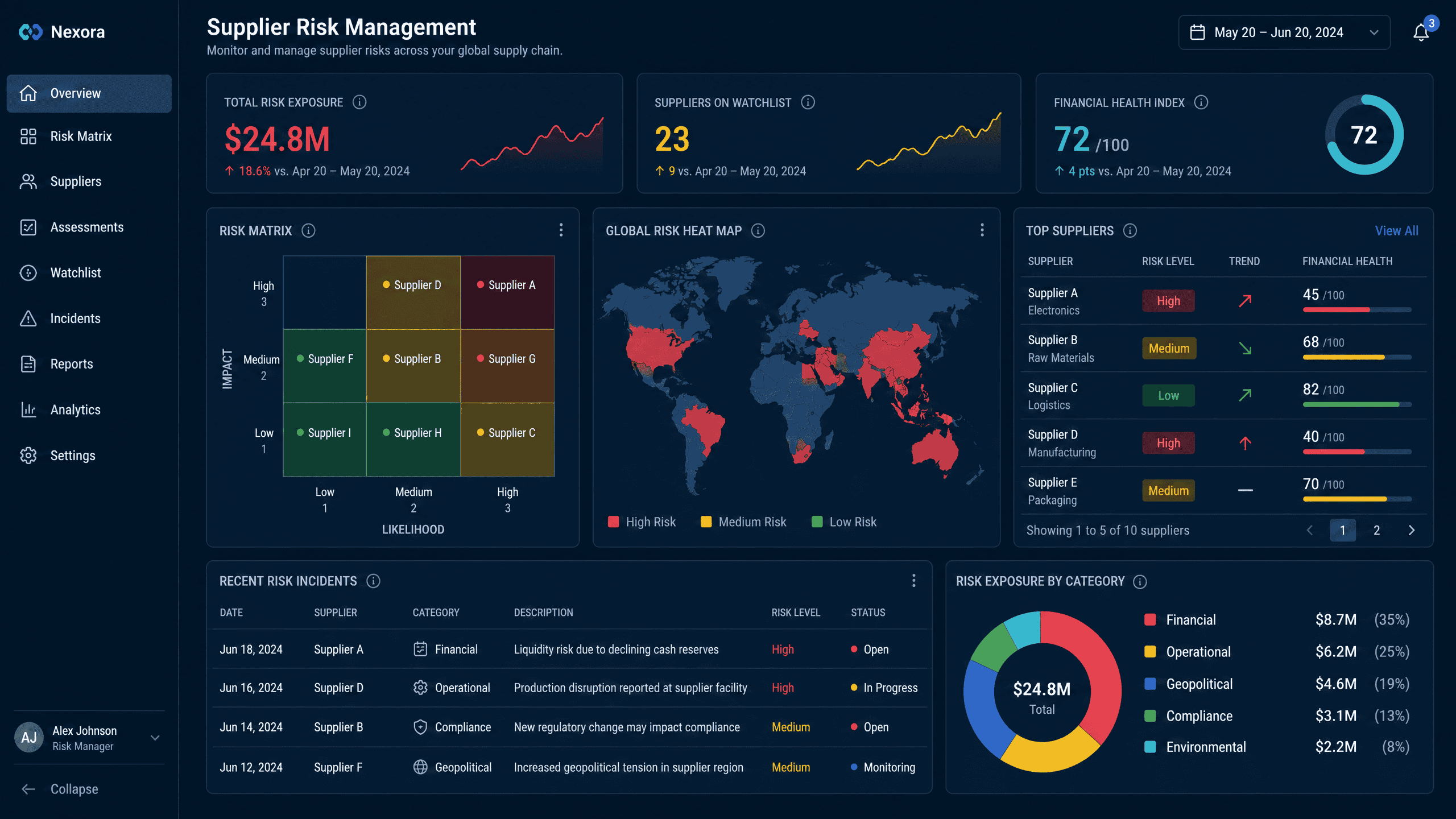
Manually maintaining risk matrices in Excel spreadsheets quickly reaches its limits when dealing with hundreds or thousands of suppliers. Effective risk management requires digital tools that centralize data and analyze it in real time.
3.1. The 360-Degree Supplier Profile
Modern risk and compliance management starts with a comprehensive, digital supplier profile. SC-Manager consolidates all relevant data in one place: from master data and certificates to credit reports and historical quality metrics.
External data sources (such as financial ratings from Creditreform or ESG scores from EcoVadis) can be seamlessly integrated via API interfaces. This provides a 360-degree view of each supplier.
3.2. The traffic-light system for immediate clarity
To make the complex data more intuitive for buyers, SC Manager translates all risk factors into a clear traffic-light system:
•Green: The supplier is stable, all certificates are valid, and the credit rating is good.
•Yellow: There are warning signs (e.g., an ISO certificate about to expire or a slight decline in quality metrics).
•Red: Acute risk (e.g., imminent insolvency or serious compliance violation).
This visual feedback enables the purchasing department to operate according to the “management by exception” principle: Attention is immediately focused on the red and yellow suppliers, while the green ones are largely managed automatically.
4. AI-powered early warning systems: The SC Agent
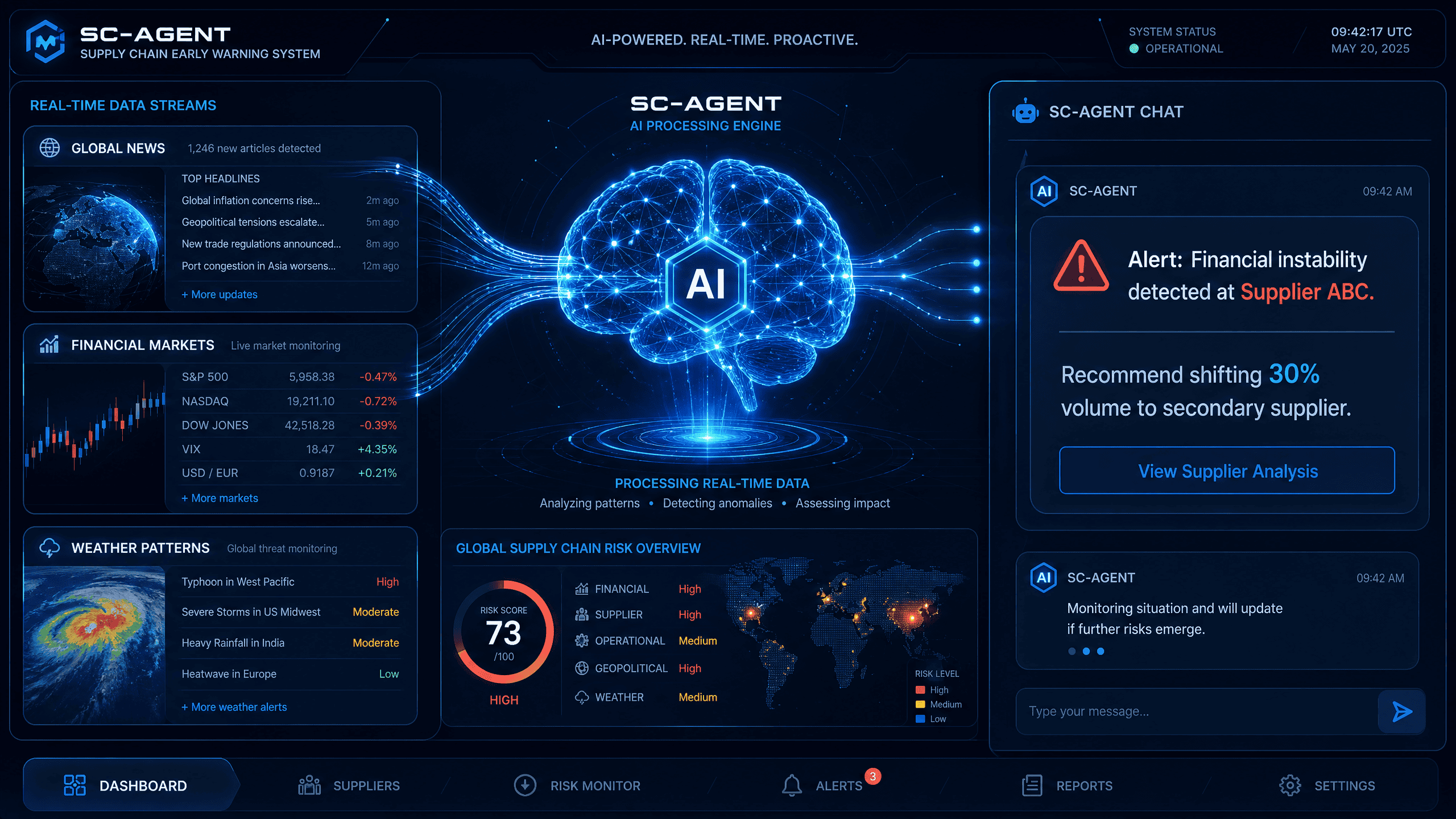
The use of artificial intelligence (AI) is bringing about a true revolution in risk management. While traditional systems often analyze only historical data, AI-powered early-warning systems look to the future.
4.1. Predictive Risk Analytics
The SC Agent from Simmeth System uses predictive analytics to anticipate disruptions. It continuously scans thousands of global news sources, weather data, social media feeds, and sanctions lists. For example, if the AI detects reports of an impending port strike in Asia or financial irregularities at an upstream supplier, it immediately sounds the alarm.
4.2. Communicative Data Analysis
What makes SC-Agent unique is its ability to analyze data through communication. Buyers no longer have to click their way through complex dashboards; instead, they can ask the system questions using natural language:
•”Which of our suppliers are affected by the new U.S. tariffs?”
•”Show me all suppliers with a red light in the Electronics product category.”
•”How will the earthquake in Taiwan affect our ability to deliver in the next quarter?”
The SC Agent not only provides the answers, but also generates detailed PDF reports on demand or suggests specific courses of action (e.g., engaging a second supplier).
5. Implementation: 4 Steps to Proactive Risk Management
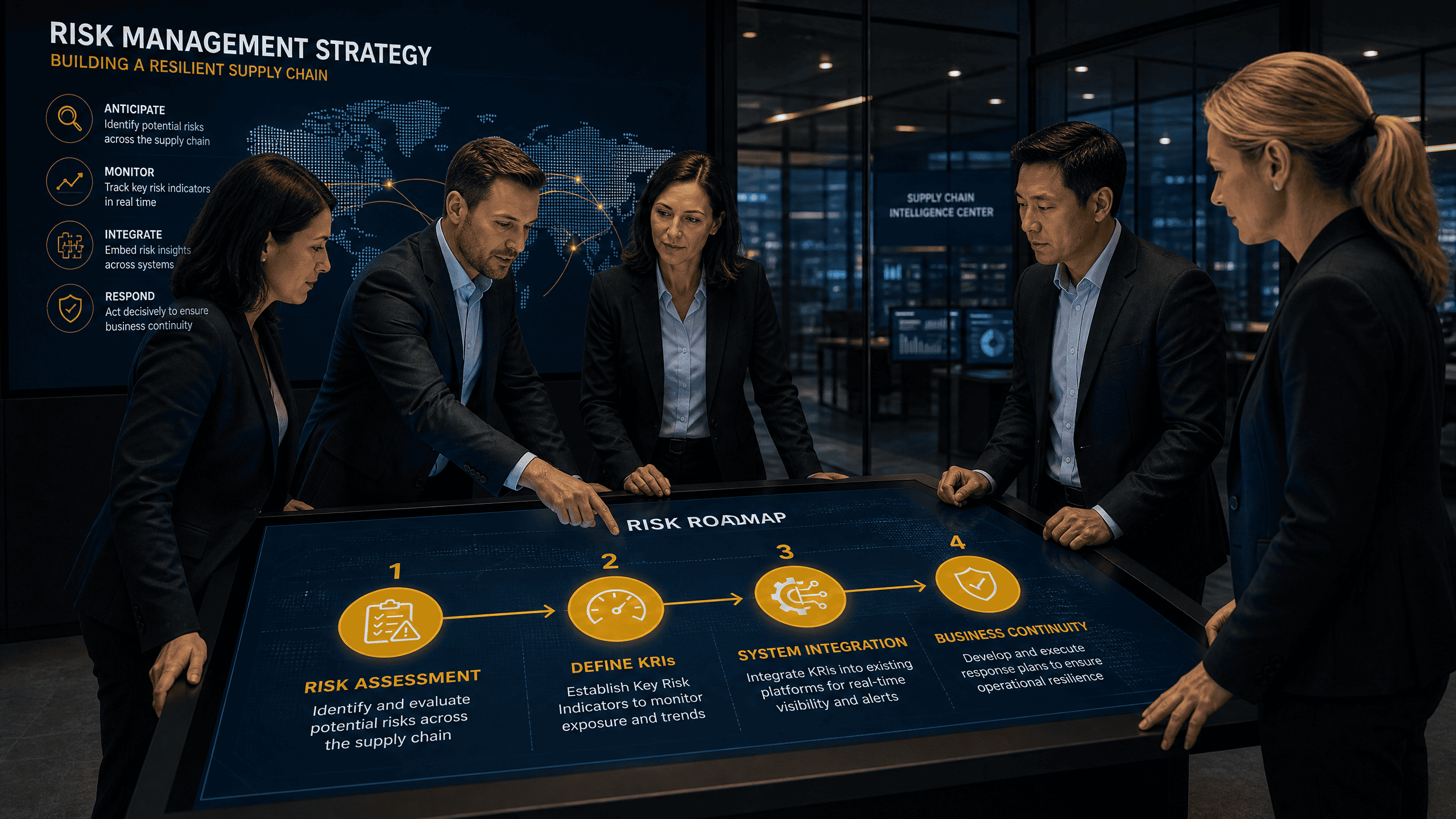
Implementing a systematic risk management system is a strategic project. The following roadmap shows how companies can successfully manage this process.
Step 1: Risk Assessment and Classification
First, all suppliers and product categories must be classified. Not every supplier requires the same level of monitoring. Categorizing them as strategic partners, bottleneck suppliers, and standard suppliers helps focus resources on the truly critical areas.
Step 2: Defining Key Risk Indicators (KRIs)
Key Risk Indicators (KRIs) are defined for critical suppliers. These can include financial metrics, quality rates, or geopolitical indices. It must be clearly defined at what threshold (e.g., credit rating index > 300) the traffic light changes from green to yellow or red.
Step 3: Digitization and System Integration
Manually monitoring KRIs is inefficient. In the third step, a software solution such as SC-Manager is implemented. ERP systems are connected, external data sources are integrated, and the traffic-light system is configured.
Step 4: Establishing Emergency Plans (Business Continuity)
Risk management is effective only when it is clear what to do in the event of an emergency. Detailed emergency plans (business continuity plans) must be developed for the greatest risks. This includes, for example, qualifying alternative suppliers (multi-sourcing) or building up strategic buffer inventories.
6. Conclusion: Risk Management as a Value Driver
Risk management in procurement is often viewed as merely a cost factor or a tedious formality. Yet in a volatile world, it is a key driver of value. Companies that proactively manage risks not only avoid costly production downtime but can also act more quickly and flexibly than their competitors in times of crisis.
With the SC Manager and the AI-powered SC Agent, Simmeth System provides the technological foundation for monitoring supplier risks in real time, making complex data sets intuitively usable, and securing the supply chain in a sustainable manner. Transform your purchasing department from a reactive procurement unit into a strategic risk manager.
7. FAQ: Frequently Asked Questions About Risk Management in Procurement
1. What is the difference between risk management and supplier evaluation?
Supplier evaluation primarily looks to the past and assesses past performance (quality, on-time delivery). Risk management looks to the future and assesses the likelihood of future disruptions (bankruptcy, geopolitical crises). Both disciplines complement each other perfectly.
2. What are the most critical risks in procurement?
This depends heavily on the industry. For manufacturing companies, operational risks (quality defects, supply disruptions) and financial risks (supplier insolvency) are usually the most critical. However, geopolitical and compliance risks (LkSG) are also increasingly coming into focus.
3. How does the traffic light system work in SC Manager?
The traffic-light system aggregates various risk factors (creditworthiness, certificates, quality) into a single visual overall status. Green means “everything is fine,” yellow indicates “increased attention required,” and red stands for “acute risk and immediate action required.”
4. What is an AI-powered early warning system?
An AI-powered early-warning system like the SC-Agent continuously scans global data sources (news, weather, financial data) to identify patterns that indicate future disruptions. It proactively alerts the buyer before the problem reaches their own supply chain.
5. How does the Kraljic Matrix help with risk management?
The Kraljic Matrix helps with prioritization. It segments procurement items based on their impact on the company’s bottom line and the procurement market risk. This allows the procurement department to focus its resources on monitoring “strategic items” and “bottleneck items.”
6. What is supply chain mapping?
Supply chain mapping is the detailed mapping of the entire supply chain—not only direct suppliers (Tier 1) but also upstream suppliers (Tier 2, Tier 3). This is essential for uncovering hidden dependencies and risks deep within the supply chain.
7. How do I integrate external risk data?
Modern software solutions such as SC-Manager feature API interfaces. These allow data from external providers (e.g., Creditreform for creditworthiness, EcoVadis for ESG risks) to be automatically imported into the supplier profile.
8. How much does it cost to implement a digital risk management system?
Costs vary depending on the size of the company and the scope of features. However, they should always be considered in relation to the potential costs of a single production shutdown (which can quickly run into the millions). Risk management is insurance for the supply chain.
9. Can risk management also reveal opportunities?
Yes. A deep understanding of procurement markets not only reveals risks but also opportunities—such as the possibility of reducing costs or improving quality by switching to a more innovative supplier.
10. How does the SC Agent assist with data analysis?
The SC Agent enables conversational data analysis. Buyers can ask questions in natural language (e.g., “Which suppliers pose a high financial risk?”). The AI analyzes the data in real time and provides precise answers and recommendations for action.