



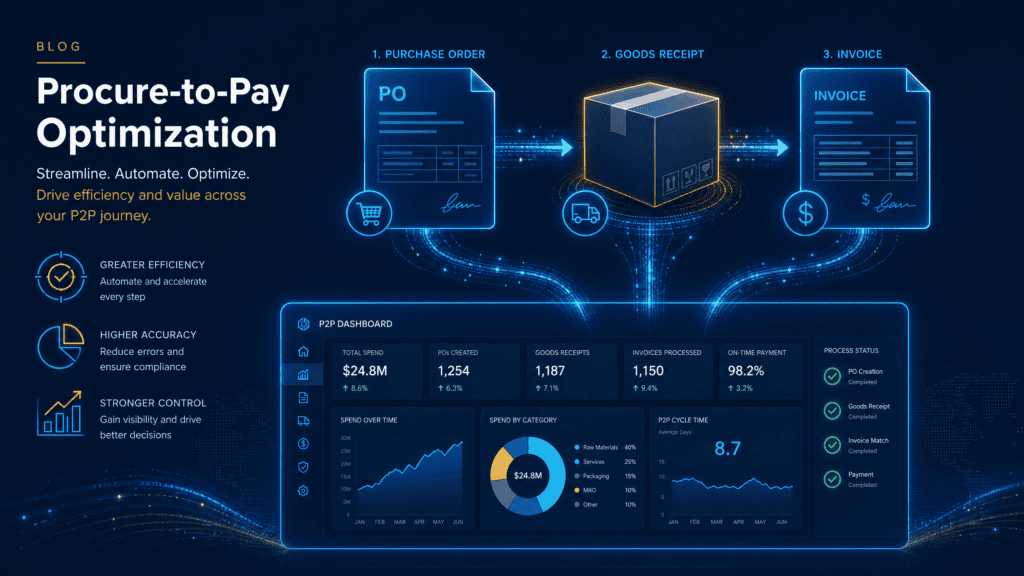
The procure-to-pay (P2P) process is the operational backbone of every company. It encompasses the entire cycle, from the requisition of goods through the purchase order and goods receipt to the final payment of invoices. Although this process takes place hundreds of times a day in every company, it is often characterized by inefficiencies, data silos, and manual tasks.
This article explores how companies can optimize their P2P process through targeted automation and intelligent supplier collaboration. It explains why seamless integration with existing ERP systems is essential and how modern software solutions—such as SC-Manager —accelerate the entire procurement cycle, minimize error rates, and strengthen supplier relationships in the long term.
1. What is the Procure-to-Pay (P2P) process?
The procure-to-pay process (often also referred to as purchase-to-pay) describes the complete operational procurement process. In contrast to strategic procurement (Source-to-Contract), which deals with supplier selection and contract negotiation, P2P focuses on transactional processing.
1.1. The Traditional Phases of the P2P Process
A typical P2P cycle goes through the following stages:
- Purchase Requisition: An employee or department submits a request for goods or services.
- Approval: The requisition is reviewed (usually in a multi-step process) and approved.
- Purchase Order: A formal purchase order is generated from the approved request and sent to the supplier.
- Order Confirmation: The supplier confirms receipt of the purchase order, as well as the delivery date and price.
- Goods Receipt: The delivered goods are physically received and recorded in the system.
- Invoice Receipt: The supplier’s invoice is received.
- Invoice Matching: The invoice is reconciled with the purchase order and the goods receipt (three-way match).
- Payment: After successful verification, the invoice is released for payment and settled.
1.2. Typical Weaknesses in Traditional P2P
In many companies, this process remains highly fragmented. Orders are sent via email or even fax, order confirmations must be manually entered into the ERP system, and invoices circulate as paper documents in internal mail folders.
These media breaks result in high processing costs, long turnaround times, a high risk of errors, and a lack of transparency. In addition, they tie up valuable resources in purchasing and accounting, which are then unavailable for strategic tasks.
2. The Benefits of an Optimized P2P Process
The digitization and automation of the P2P process offer far-reaching benefits that go well beyond mere cost savings.
2.1. Increased Efficiency and Cost Reduction
Automating routine tasks (e.g., automatic order generation from approved purchase requests or automatic invoice reconciliation) drastically reduces process costs per transaction. According to the German Association for Materials Management, Purchasing, and Logistics (BME), the costs of processing an order can be reduced by up to 70% through end-to-end digitization.
2.2. Increased Transparency and Compliance
A digital P2P process leaves a complete audit trail. Every step—from the request to payment—is documented and traceable. This not only facilitates internal and external audits but also ensures that procurement guidelines (maverick buying) and compliance requirements are met.
2.3. Better Supplier Relationships
A smooth P2P process is the foundation of effective supplier relationship management. When orders are clearly communicated, inquiries are resolved quickly, and invoices are paid on time, supplier satisfaction increases. This makes the company a “customer of choice.”
3. Supplier Collaboration: The Key to P2P Success
Optimizing the P2P process must not stop at the company’s boundaries. True efficiency is only achieved when suppliers are actively integrated into the process. This is where supplier collaboration comes into play.
3.1. The Supplier Portal as a Central Hub
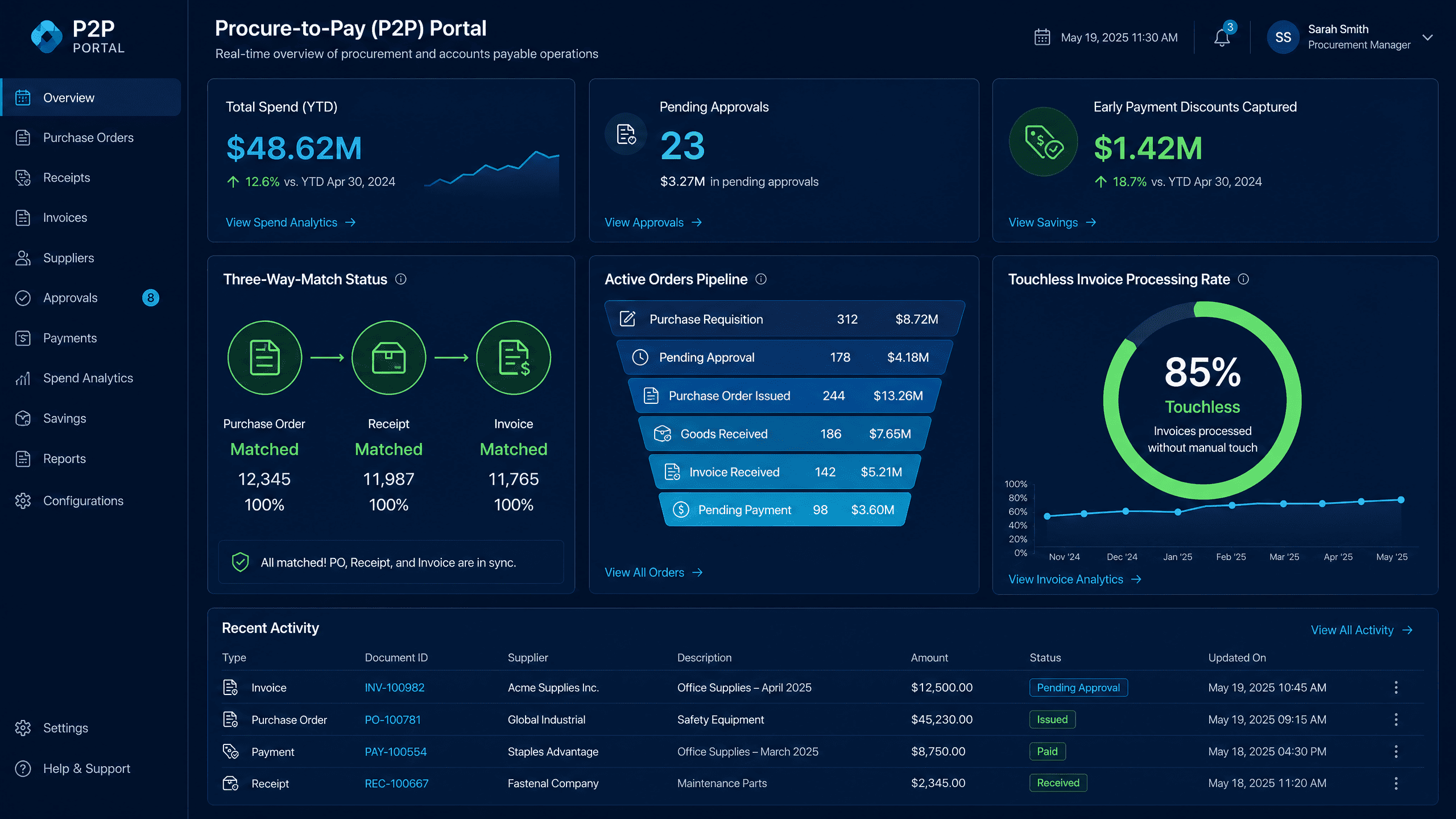
A modern supplier portal acts as a digital bridge between a company’s own ERP system and its suppliers. Instead of sending documents back and forth via email, both sides work on a shared platform.
SC-Manager offers a comprehensive collaboration module for this purpose. Orders from the ERP system are automatically made available in the portal. The supplier is notified by email, logs in, and can confirm or reject the order directly in the system, or suggest changes (e.g., a different delivery date).
3.2. Automated Data Exchange (EDI/API)
For suppliers with high transaction volumes, a web-based portal is often insufficient. In such cases, direct system-to-system integration via EDI (Electronic Data Interchange) or modern API interfaces is required.
The SC Manager supports this seamless integration. Orders, Advanced Shipping Notices (ASNs), and invoices are exchanged fully automatically between the systems. This completely eliminates the need for manual data entry on both sides.
4. Invoice Processing and AI Automation
Invoice processing is often the most time-consuming and error-prone part of the P2P process. Here, the use of artificial intelligence (AI) offers enormous potential for optimization.
4.1. Intelligent OCR Recognition
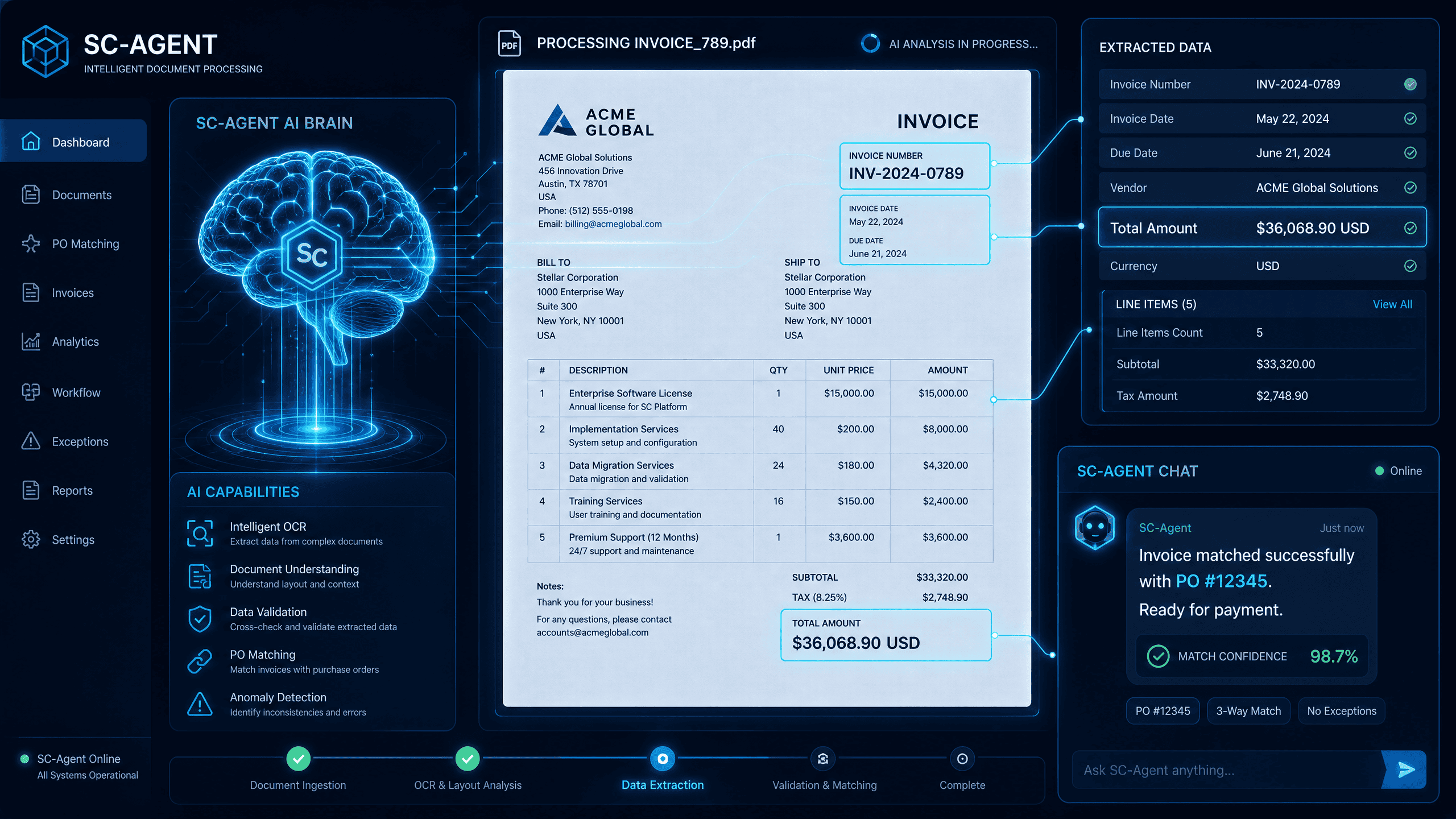
When suppliers send invoices as PDFs via email, this data must be captured in a structured manner. Modern systems such as SC-Manager use advanced OCR (Optical Character Recognition) technologies in combination with machine learning (e.g., Microsoft Form Recognizer).
The AI not only recognizes standard fields such as invoice number and amount, but can also extract complex table structures and line item data. The recognized data is automatically reconciled with the original purchase order and the goods receipt.
4.2. The SC Agent in the P2P Process
Simmeth System’s integrated SC Agent proactively supports buyers and accountants. In the event of discrepancies (e.g., the invoice price is higher than the order price), the agent triggers an alert and automatically forwards the invoice to the responsible buyer for clarification.
In addition, the SC Agent enables conversational data analysis. Users can ask questions such as, “Which invoices from Supplier X are currently past due?” or “What is our discount loss rate for the current quarter?” and receive precise answers immediately.
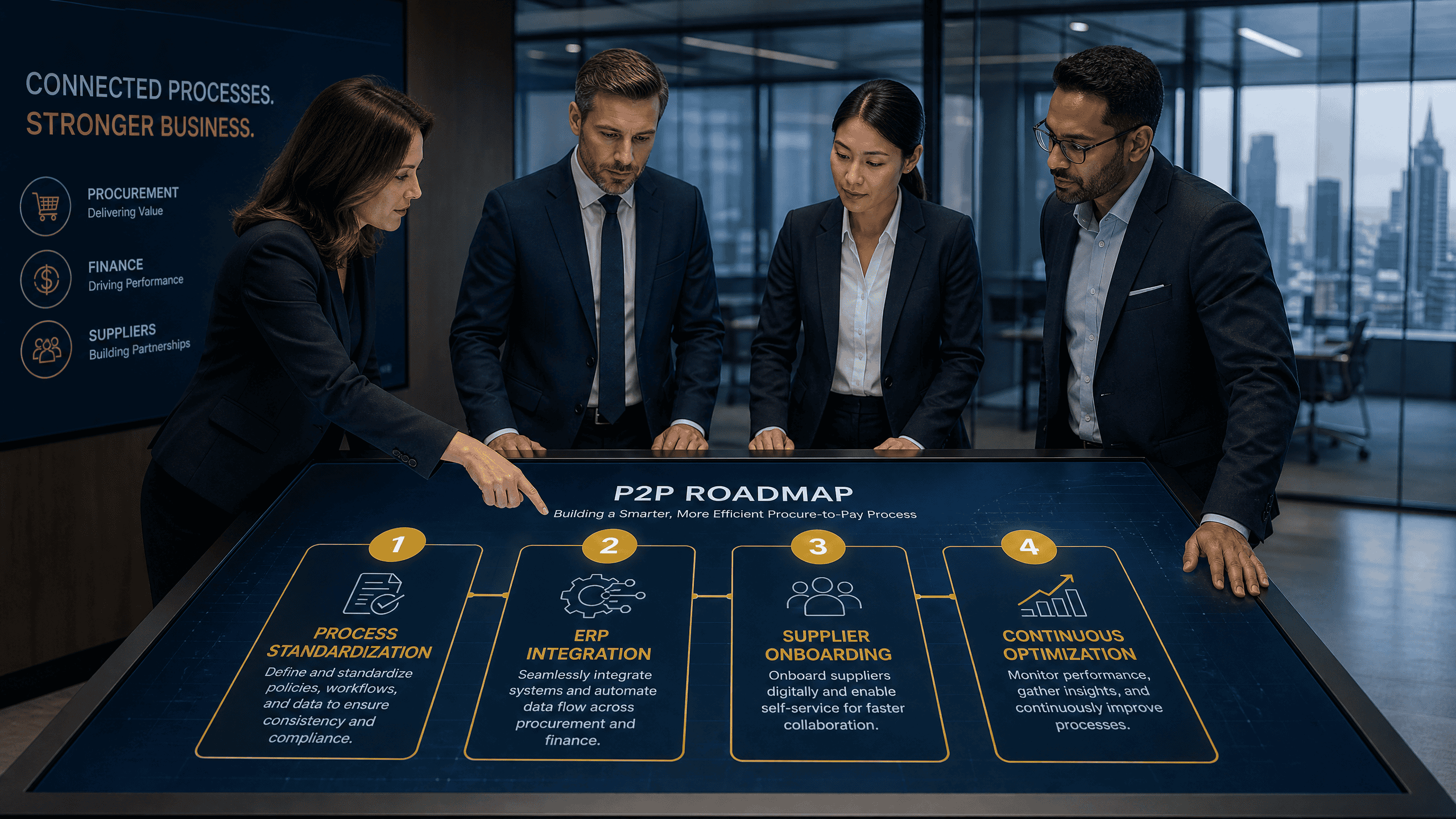
5. Implementation: 4 Steps to Digital P2P
The digitization of the P2P process is a transformation project that must be carefully planned. The following roadmap has proven effective in practice.
Step 1: Process Analysis and Standardization
Before software is implemented, existing processes must be analyzed. Where are there media breaks? Why do invoice discrepancies occur? The processes should first be standardized and simplified before they are digitized.
Step 2: System Selection and ERP Integration
Choosing the right software is crucial. The solution must integrate seamlessly with the existing ERP system (e.g., SAP, Microsoft Dynamics). SC-Manager offers standardized interfaces for this purpose that ensure bidirectional data exchange in real time.
Step 3: Supplier Onboarding
A P2P portal is only as good as its users. Supplier onboarding must be made as simple as possible. Clearly communicating the benefits (e.g., faster payment, fewer follow-up inquiries) and providing intuitive user interfaces are key to success here.
Step 4: Continuous Monitoring and Optimization
After the go-live, the continuous optimization phase begins. Using the SC Manager’s key metrics and reporting functions, throughput times, automation rates (touchless rate), and error rates can be monitored and specifically improved.
6. Conclusion: P2P Optimization as a Competitive Advantage
An optimized procure-to-pay process is far more than just an administrative efficiency project. It is the prerequisite for agile, responsive procurement and stable supply chains.
Companies that fully digitize their P2P processes, eliminate media breaks, and integrate their suppliers via modern collaboration portals not only drastically reduce their process costs. They also create the transparency and flexibility that strategic procurement needs to focus on value-adding tasks such as risk management and supplier development.
With SC-Manager, Simmeth System offers an integrated platform that automates the entire P2P cycle—from ordering to invoice verification—and takes it to a new level of efficiency through AI-powered analytics.
7. FAQ: Frequently Asked Questions About the P2P Process
1. What is the difference between Source-to-Contract (S2C) and Procure-to-Pay (P2P)?
S2C encompasses the strategic phases of procurement: supplier sourcing, request for proposals, negotiation, and contract execution. P2P covers the operational, transactional phases: requisition, purchase order, goods receipt, and invoice verification.
2. What does “three-way match” mean in accounts receivable?
The three-way match is a verification process in which three documents are compared: the purchase order, the goods receipt, and the invoice. The invoice is released for payment only if the quantities and prices match on all three documents.
3. How does a P2P system reduce “maverick buying”?
“Maverick buying” refers to purchasing that bypasses official procurement processes and framework agreements. A P2P system channels all requests through defined approval workflows and electronic catalogs, thereby drastically reducing uncontrolled spending.
4. Do suppliers have to pay to use the SC-Manager portal?
No, use of the supplier portal is generally free of charge for suppliers. This lowers the barrier to entry and promotes high adoption and usage rates.
5. How does the SC Manager’s ERP integration work?
SC-Manager features standardized interfaces (APIs) to all common ERP systems (e.g., SAP, Microsoft Dynamics, Infor). Purchase orders are transferred from the ERP system to SC-Manager, and confirmations or invoice data are automatically fed back into the ERP system.
6. What is the “touchless rate” in the P2P process?
The touchless rate (automated processing rate) indicates the percentage of invoices that the system processes fully automatically—from receipt through payment approval—without requiring manual intervention by an employee. A high touchless rate is the primary goal of P2P optimization.
7. How does AI support invoice processing?
AI-powered OCR (Optical Character Recognition) systems can extract invoice data from PDFs, even when the invoice layout is unknown. Machine learning algorithms learn from manual corrections and continuously improve the recognition rate.
8. Can the P2P process also be used to map services?
Yes. While a goods receipt is posted for physical goods, a service entry (Service Entry Sheet) is created for services. The SC Manager also supports these processes through corresponding approval workflows.
9. How does P2P improve liquidity planning?
By digitally recording orders and invoices early on, the finance department has an accurate overview of upcoming payment obligations at all times. This enables precise cash flow planning and the strategic use of cash discounts.
10. Is a P2P system also a good fit for small and medium-sized businesses?
Absolutely. Even in small and medium-sized businesses, manual ordering and invoicing processes tie up a huge amount of resources. Cloud-based solutions like SC-Manager are scalable and often pay for themselves within the first year thanks to the savings in process costs.